
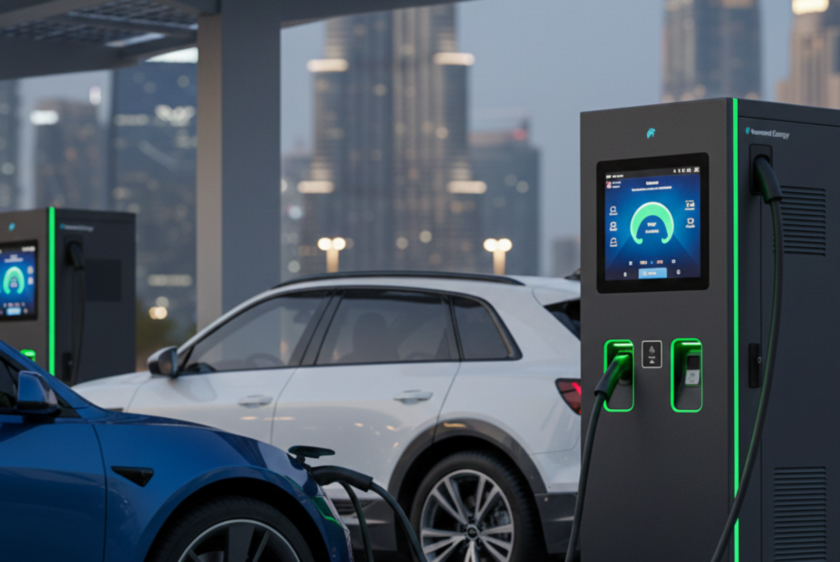
The Middle East—especially the United Arab Emirates—is undergoing a remarkable transformation in mobility. Traditionally known for its oil-rich economy and fuel-based transportation systems, the region is now rapidly embracing electric vehicles (EVs). With government initiatives, technological advancements, and growing environmental awareness, EV adoption is accelerating at an unprecedented pace.
But does this mean gasoline stations are disappearing? Or is the reality more nuanced?
This blog explores how EVs are reshaping the UAE’s transport ecosystem, the role of infrastructure, and what the future holds.
The EV Boom in the UAE: A Market on Fast-Forward
The UAE has positioned itself as one of the fastest-growing EV markets in the Middle East. While EVs still represent a smaller portion of total vehicles, their growth trajectory is steep and undeniable.
- EV sales in the UAE surged significantly, with around 73% year-on-year growth in 2025
- Dubai alone recorded over 40,600 EVs in just the first half of 2025
- The EV market is projected to reach $16.3 billion by 2030, growing at over 40% annually
This rapid expansion signals a clear shift: EVs are no longer a niche trend—they are becoming mainstream.
Why EV Adoption is Accelerating in the UAE
1. Strong Government Vision & Policies
The UAE government has set ambitious sustainability goals, including:
- 50% of all vehicles to be electric by 2050
- National EV policies supporting infrastructure and adoption
- Incentives such as free parking, reduced registration fees, and toll exemptions
These policies are part of a broader strategy to reduce carbon emissions and diversify the economy beyond oil.
2. Rapid Charging Infrastructure Expansion
One of the biggest drivers of EV growth is the expansion of charging networks.
- Over 1,270 public charging stations in Dubai by mid-2025
- New ultra-fast chargers reducing charging time to under 30 minutes
- Charging stations increasingly integrated into urban planning
Interestingly, many of these charging points are being installed at or near traditional petrol stations, showing a transition rather than a complete replacement.
3. Rising Fuel Costs & Cost Efficiency of EVs
While fuel is relatively affordable in the UAE compared to global standards, EVs still offer long-term savings:
- Lower maintenance costs
- Reduced fuel expenses
- Increasing availability of affordable used EVs
The 41% growth in the used EV market in 2025 highlights how EV ownership is becoming accessible to a wider population
4. Consumer Awareness & Sustainability Trends
Consumers in the UAE are becoming more environmentally conscious. EVs are seen as:
- Eco-friendly alternatives
- Technologically advanced vehicles
- Status symbols aligned with innovation
Surveys indicate strong satisfaction among EV owners, with many planning to stick with electric mobility long-term
Are Gas Stations Really Being Replaced?
The idea that gasoline stations are disappearing is partly true—but not entirely accurate.
The Reality: Evolution, Not Elimination
Instead of vanishing, fuel stations are evolving into energy hubs:
- Adding EV charging points
- Offering hybrid fueling solutions
- Integrating smart energy services
For example, many EV chargers are now installed within existing petrol station networks, creating a dual-energy ecosystem.
Why Gas Stations Still Matter (For Now)
- EVs still represent a minority of total vehicles
- Long-distance travel still depends on fuel infrastructure
- Charging networks, while growing, are not yet universal
This means gasoline stations will co-exist with EV charging infrastructure for decades.
The Role of Dubai: The EV Capital of the Region
Within the UAE, Dubai leads the EV revolution.
Key highlights:
- Fastest EV adoption rate in the country
- Strong infrastructure backed by DEWA and RTA
- Smart city initiatives promoting green mobility
Dubai’s approach combines technology, policy, and infrastructure, making it a global benchmark for EV adoption.
Challenges Slowing Full Transition
Despite rapid growth, some barriers remain:
1. High Initial Costs
EVs are still more expensive upfront compared to traditional cars.
2. Charging Limitations
Although improving, charging infrastructure still faces:
- Accessibility issues in some areas
- Longer charging times compared to refueling
3. Insurance & Maintenance Costs
EV insurance can be higher due to specialized components
Future Outlook: What to Expect by 2030 and Beyond
The UAE’s EV journey is just beginning. Here’s what the future looks like:
1. Mass EV Adoption
EVs are expected to become a significant share of new car sales by 2030.
2. Smart Energy Ecosystems
Fuel stations will transform into:
- Charging hubs
- Renewable energy centers
- Mobility service stations
3. Autonomous & Connected Vehicles
EV adoption will align with advancements in:
- Self-driving technology
- Smart transportation systems
EVs vs Gasoline: A Coexistence Phase
Rather than a sudden replacement, the UAE is experiencing a transition phase:
Aspect Gasoline Vehicles Electric Vehicles Infrastructure Mature & widespread Rapidly growing Cost (long-term) Higher fuel costs Lower running costs Environmental impact High emissions Low emissions Adoption rate Declining slowly Increasing rapidly Conclusion: A Transformation in Progress
The UAE is not just adopting electric vehicles—it is redefining the future of mobility in the Middle East.
While gasoline stations are not disappearing overnight, they are evolving to meet new energy demands. The rapid rise of EVs, backed by strong government support and infrastructure growth, signals a future where electric mobility becomes the norm.
In the coming years, the question won’t be whether EVs will replace gasoline vehicles—but how quickly the transition will happen.