
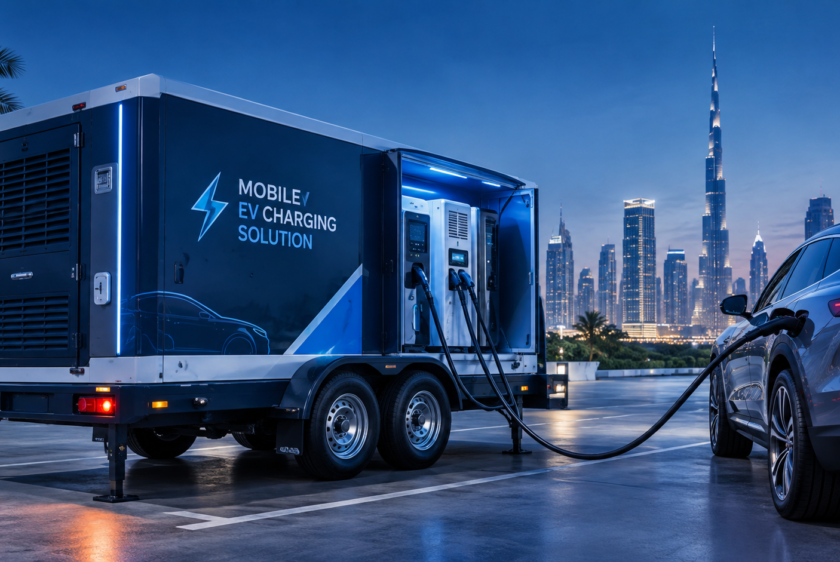
As electric vehicle adoption continues to grow, businesses, fleet operators, property developers, event organizers, and roadside service providers need charging solutions that are flexible, reliable, and capable of being deployed where and when they are needed. Mobile EV charger installation remains an important part of building permanent charging infrastructure, but not every location has immediate access to sufficient electrical capacity or a suitable grid connection. This is where mobile charging technology can provide a practical alternative. Modern Mobile EV charger installation, DC fast charger installation, and EV charging turnkey solutions can work together with mobile charging systems to support businesses that need rapid, high-power charging without waiting for permanent infrastructure.
Newmont Energy provides Mobile EV Charging Solutions across the UAE, designed for applications where grid access is limited, temporary charging is required, or rapid deployment is important. Its mobile EV charging trailer provides 210 kWh of energy storage and high-power DC charging of up to 180 kW, with CCS1 and CCS2 charging options. The solution is designed for commercial parking, fleets, events, roadside assistance, infrastructure projects, and other demanding applications.
1. Why EV Charger Installation Is Important for the UAE’s Growing EV Market
The transition toward electric mobility is changing the way businesses, property owners, fleet operators, and public facilities think about transportation infrastructure. As more electric vehicles enter the UAE market, convenient access to charging becomes increasingly important. Traditional EV charger installation provides a permanent charging point connected to a property’s electrical infrastructure, while mobile EV charging can provide additional flexibility when permanent charging capacity is unavailable or when charging demand changes from one location to another.
For many businesses, installing permanent chargers can involve site assessment, electrical planning, equipment selection, cabling, protection systems, commissioning, and network integration. These steps are essential for long-term charging infrastructure, but they may not always be immediately practical for temporary locations, construction projects, events, remote areas, or businesses waiting for permanent electrical upgrades.
Mobile charging provides another layer of flexibility. Instead of depending entirely on a fixed charging location, businesses can move charging capacity to where it is required. This makes mobile EV charging particularly relevant to UAE applications where operational requirements can change quickly.
Key situations where mobile charging can complement traditional EV charger installation include:
- Temporary charging requirements at events and exhibitions.
- Fleet charging at logistics and industrial locations.
- Emergency roadside charging and breakdown recovery.
- Charging at locations where permanent grid infrastructure is limited.
- Construction and infrastructure projects.
- Commercial parking areas experiencing temporary increases in EV demand.
- Remote or difficult-to-access charging locations.
- Temporary charging support while permanent EV infrastructure is being developed.
Newmont Energy states that its mobile EV charging system is designed for Dubai, Abu Dhabi, Sharjah, and other Emirates, supporting commercial parking, real estate developments, fleets, events, roadside assistance, and EV infrastructure projects.
2. How DC Fast Charger Installation and Mobile Charging Work Together
Charging speed is an important consideration for commercial EV operations. While AC chargers can be suitable for vehicles that remain parked for several hours, many fleet, public, roadside, and high-utilization applications require faster energy delivery. This is where DC fast charger installation becomes particularly relevant.
Unlike conventional AC charging, DC fast charging delivers direct current to the vehicle’s battery system, allowing compatible vehicles to receive energy at significantly higher power levels. A properly planned DC fast charger installation can support locations where drivers need to minimize charging time and return to the road quickly.
However, permanent DC fast charger installation may require substantial electrical capacity and infrastructure planning. Mobile DC charging can provide an alternative for situations where permanent infrastructure is not immediately available.
Newmont Energy’s mobile charger provides up to 180 kW of charging power with dual output and supports CCS1 and CCS2 standards. The system has a 210 kWh battery capacity and a 200–1000 V DC voltage range, making it designed for high-power mobile charging applications.
Businesses considering DC fast charger installation can therefore look at mobile charging as either a temporary solution, supplementary capacity, or an operational backup depending on their site requirements.
Important considerations include:
- Required charging power.
- Number of vehicles requiring simultaneous charging.
- Vehicle charging standards and connector compatibility.
- Available electrical infrastructure.
- Expected charging frequency.
- Vehicle turnaround requirements.
- Site accessibility.
- Temporary versus permanent charging requirements.
- Future expansion plans.
The right combination of permanent EV charger installation and mobile DC charging can help businesses respond to different charging requirements without relying on one infrastructure model for every situation.
3. EV Charging Turnkey Solutions for Commercial and Fleet Operations
For businesses, EV charging is rarely just about purchasing a charger. A successful charging project may require equipment, planning, installation, commissioning, software connectivity, maintenance, technical support, and ongoing operational management. This is why EV charging turnkey solutions are becoming increasingly relevant for businesses that want to simplify the deployment and management of charging infrastructure.
An EV charging turnkey solution can bring multiple stages of a charging project together. Instead of managing separate suppliers for equipment, integration, installation support, software, and maintenance, businesses can work with a coordinated charging solution provider.
Mobile charging can be integrated into this broader approach. Newmont Energy describes its mobile charging offering as including equipment supply, CPO integration support, installation guidance, smart charging backend connectivity, and after-sales service and maintenance.
This approach can be useful for:
- Commercial property developers.
- Shopping malls and retail parking operators.
- Hotels and hospitality businesses.
- Airports and transport hubs.
- Logistics companies.
- Corporate EV fleet operators.
- Charge Point Operators.
- Municipalities.
- Industrial facilities.
- Event organizers.
- Roadside assistance providers.
For a fleet operator, for example, permanent EV charger installation may be the long-term objective, while mobile charging can provide additional capacity during peak demand or operational disruptions. For an event organizer, a mobile charger can provide temporary charging without requiring a permanent charging station to be constructed at the venue.
A comprehensive EV charging turnkey solution should therefore consider not only the charger itself but also the operational environment in which it will be used.
4. Mobile EV Charging Applications Across Dubai and the UAE
One of the biggest advantages of mobile EV charging is its ability to serve different locations and use cases. Permanent EV charger installation works particularly well when a site has predictable demand and suitable electrical infrastructure. Mobile charging can provide additional flexibility when charging requirements are temporary, mobile, emergency-based, or difficult to predict.
Newmont Energy identifies several applications for its mobile EV charging system, including commercial and public infrastructure, fleet and logistics operations, events and temporary installations, and emergency and roadside assistance.
Commercial and public infrastructure can include:
- Shopping malls and retail parking.
- Hotels and hospitality venues.
- Airports and transportation hubs.
- Business parks.
- Commercial developments.
Fleet and logistics applications can include:
- Delivery vehicle fleets.
- Corporate electric vehicle fleets.
- Industrial zones.
- Warehouses.
- Logistics operations.
Temporary applications can include:
- EV exhibitions.
- Automotive events.
- Construction projects.
- Infrastructure projects.
- Temporary charging zones.
Emergency applications can include:
- EV breakdown recovery.
- Remote charging locations.
- Highway support.
- Desert access areas.
This flexibility makes mobile charging an important complement to EV charger installation. A business does not necessarily have to choose between permanent and mobile infrastructure. Depending on operational requirements, both approaches can be used as part of a wider charging strategy.
For example, a commercial property could use permanent chargers for everyday charging while deploying mobile charging capacity during special events or periods of unusually high demand. A fleet operator could use permanent DC fast charger installation at its main depot while using mobile charging to support vehicles at temporary or remote locations.
5. Technology, Safety, and Performance in UAE Conditions
Charging equipment used in the UAE must be capable of operating in demanding environmental conditions. High temperatures, dust, outdoor exposure, and intensive utilization can all affect charging infrastructure. Therefore, choosing equipment designed for the local operating environment is an important part of both EV charger installation and mobile EV charging deployment.
Newmont Energy’s mobile EV charger is specified for operating temperatures from -20°C to 65°C. The system uses liquid-cooled thermal management and has IP54 protection for the machine and IP67 protection for the energy storage system. The manufacturer also specifies a C4 anti-corrosion housing and a battery lifecycle of more than 5,000 cycles under stated test conditions.
Connectivity is another important consideration. The mobile charger uses OCPP 1.6 communication, which can support integration with compatible smart charging and backend systems. This can provide charging operators with greater visibility into charging operations and help integrate mobile charging into broader network management strategies.
Important technology considerations include:
- High-power DC charging capability.
- CCS1 and CCS2 compatibility.
- Battery energy storage capacity.
- Thermal management.
- Environmental protection.
- Communication protocols.
- Backend connectivity.
- Equipment monitoring.
- Safe deployment procedures.
- Preventive maintenance.
For businesses investing in DC fast charger installation, these factors are equally important. Charger power alone does not determine the success of a charging deployment. Equipment durability, electrical design, network connectivity, maintenance, safety, and operational suitability all contribute to long-term performance.
A professional EV charging turnkey solution should account for these factors from the planning stage through installation, commissioning, operation, and maintenance.
6. Building a Flexible EV Charging Strategy with EV Charger Installation
The future of electric mobility will require charging infrastructure that can adapt to changing demand. Permanent EV charger installation will continue to be an important part of charging infrastructure, particularly for homes, workplaces, commercial properties, fuel stations, fleets, and public charging networks. At the same time, mobile charging can provide additional flexibility for businesses that need charging capacity beyond their permanent infrastructure.
The most effective charging strategy depends on the individual requirements of each organization. Businesses should evaluate where vehicles are located, how long they remain parked, how frequently they require charging, what charging speeds are necessary, and whether the available electrical infrastructure can support the expected demand.
A practical charging strategy can consider:
- Permanent EV charger installation for predictable, long-term charging demand.
- DC fast charger installation for locations requiring rapid charging.
- Mobile charging for temporary or emergency requirements.
- EV charging turnkey solutions for coordinated project delivery.
- Smart charging connectivity for operational visibility.
- Preventive maintenance for long-term equipment performance.
- Scalable infrastructure for future EV adoption.
- Technical support for ongoing charging operations.
Newmont Energy’s mobile solution is designed around rapid deployment and does not require a permanent grid connection, allowing businesses and operators to deploy charging capacity where it is needed. Its published specifications include 210 kWh energy storage, up to 180 kW dual-output charging, OCPP 1.6 communication, liquid cooling, and outdoor protection ratings.
For organizations developing charging infrastructure in Dubai and across the UAE, the combination of permanent EV charger installation, DC fast charger installation, and flexible mobile charging can create a more adaptable approach to electric mobility.
The key is to match the charging solution to the actual operational requirement. A workplace may need predictable AC charging, while a logistics operation may require high-power DC charging. An event may need temporary charging, while a roadside service provider may require charging that can reach vehicles in remote locations. A property developer may require a long-term EV charging turnkey solution that combines hardware, installation, network integration, and maintenance.
As EV adoption continues to develop, charging infrastructure will become an increasingly important part of commercial and transportation planning. Businesses that evaluate charging demand, electrical capacity, deployment flexibility, technology, and long-term operations can develop infrastructure that is better suited to their specific needs.
With professional EV charger installation, high-power DC fast charger installation, and comprehensive EV charging turnkey solutions, organizations can build a charging strategy that combines permanent infrastructure with the flexibility of mobile power. In the UAE’s rapidly evolving electric mobility environment, mobile EV charging provides an additional way to deliver power where it is needed, when it is needed, while supporting businesses as they expand their EV charging capabilities.