
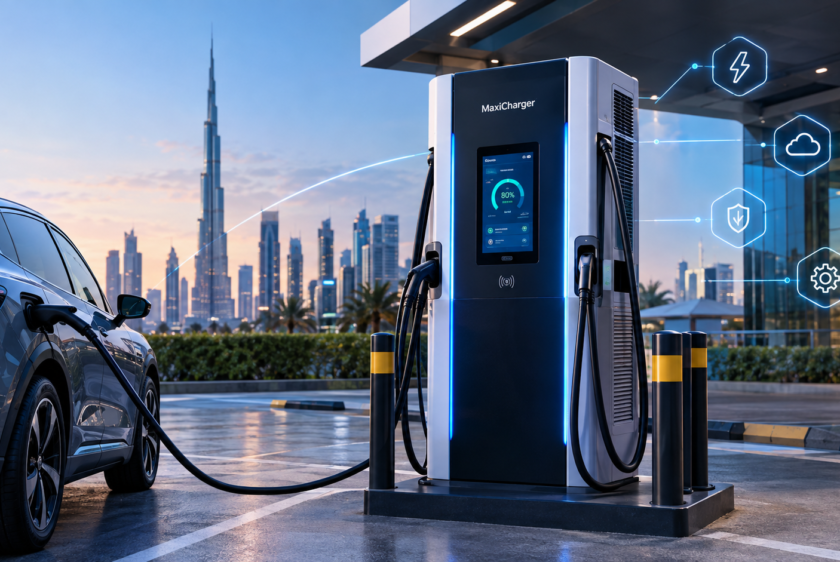
DC fast charger installation is becoming an increasingly important part of modern EV infrastructure as electric vehicle adoption continues to grow across the UAE. Businesses, commercial property owners, fleet operators, hotels, shopping malls, fuel stations, and charging network operators need reliable charging infrastructure that can deliver high charging power while supporting safety, connectivity, and long-term operational performance. A professionally planned DC fast charger installation can provide rapid charging capabilities while creating a scalable foundation for future EV charging demand. Newmont Energy’s MaxiCharger DC Fast is designed for high-power applications, with available output configurations of 60 kW, 120 kW, 180 kW, and 240 kW, making it suitable for a range of commercial and public charging environments.
1. Why DC Fast Charger Installation Matters for UAE Businesses
The charging requirements of an EV driver are different from those of a conventional petrol or diesel vehicle. Instead of simply filling a fuel tank, EV drivers need convenient access to reliable charging infrastructure. For locations where vehicles cannot remain parked for several hours, DC fast charging can provide a practical solution by delivering significantly higher charging power than typical AC charging systems.
A well-planned DC fast charger installation is therefore particularly valuable for locations with high vehicle turnover. Shopping centres, hotels, commercial properties, fleet depots, roadside facilities, fuel stations, and public charging hubs can all benefit from appropriately designed DC charging infrastructure.
Newmont Energy states that its MaxiCharger DC Fast systems have been installed at prominent locations including shopping malls, hotels, and residential areas across Dubai, Abu Dhabi, and other parts of the UAE. The product page also states that the charger can support up to 240 kW of fast charging and offers configurable power options depending on project requirements.
Key considerations when planning a DC fast charger installation include:
- Available electrical capacity at the site
- Required charging power
- Expected number of charging sessions
- Vehicle compatibility
- Charging connector requirements
- Parking layout and traffic flow
- Cable length and charger positioning
- Network connectivity
- Software and charging management requirements
- Future expansion requirements
- Maintenance and service requirements
A successful installation is not simply about placing a charger at a convenient parking location. Electrical infrastructure, software, safety, accessibility, user experience, and future scalability all need to be considered during the planning stage.
2. Understanding the MaxiCharger DC Fast Solution
The MaxiCharger DC Fast is designed as a high-power charging solution for locations that require rapid EV charging and intelligent charging management. According to the product specifications, the system is available in 60 kW, 120 kW, 180 kW, and 240 kW configurations, with an output voltage range of 150–1000 V. It can support two CCS1 outputs or a combination of one CCS1 and one CHAdeMO connection, depending on the configuration.
One of the notable features is its 27-inch LCD touchscreen interface, while connectivity options include 4G, Bluetooth, Wi-Fi, and Ethernet. The charger supports OCPP 1.6J and can be upgraded to OCPP 2.0.1, allowing it to integrate with compatible charging management platforms.
The product page also highlights triple protection technology, intelligent battery management, real-time analysis through Charger, Cloud BMS, and VCI, and an AI-based health charging mode. Newmont states that this health charging mode can provide up to 20% extra battery saving under its stated operating approach.
Important MaxiCharger DC Fast characteristics include:
- 60 kW to 240 kW output configurations
- 150–1000 V output voltage range
- CCS1 and optional CHAdeMO charging configurations
- Up to 400A peak current depending on configuration
- ≥95% average efficiency at full power
- 27-inch LCD touchscreen
- 4G, Wi-Fi, Bluetooth, and Ethernet connectivity
- OCPP 1.6J with upgrade capability to OCPP 2.0.1
- RFID and app-based authentication
- Optional credit-card authentication
- OTA software updates
- NEMA 3R enclosure rating
- Operating temperature range of -35°C to +55°C
- 24-month warranty with extension options
These capabilities make the MaxiCharger DC Fast suitable for projects where speed, connectivity, monitoring, and operational flexibility are important.
3. How Professional DC Fast Charger Installation Works
A professional DC fast charger installation begins well before the physical charger is delivered to the site. The first stage is normally a site assessment to understand the property’s electrical infrastructure, available space, vehicle movement, charging demand, and future requirements.
Electrical capacity is particularly important for high-power DC charging. A 240 kW charger requires significantly more electrical infrastructure than a standard AC wallbox. Before installation, the available electrical supply, distribution equipment, cable routes, protection systems, earthing, and other site requirements should be evaluated by qualified professionals.
Newmont Energy’s EV charger installation guidance similarly emphasizes evaluating existing connected load, maximum demand, spare electrical capacity, distribution boards, transformer capacity, cable routes, and earthing arrangements before selecting and deploying charging equipment.
A typical DC fast charger installation project can involve:
- Site survey and feasibility assessment
- Electrical load assessment
- Charger capacity selection
- Connector compatibility assessment
- Site layout and parking design
- Electrical and civil works planning
- Charger positioning
- Cable routing and protection
- Network connectivity configuration
- Software and backend integration
- Equipment installation
- Testing and commissioning
- User authentication setup
- Operational monitoring
- Maintenance planning
The right charger capacity should also be selected according to the vehicles using the site. A location serving passenger vehicles may have different requirements from a fleet depot, commercial hub, or high-traffic public charging station.
4. EV Charging Turnkey Solutions for Complete Infrastructure
Installing the charger is only one part of creating a reliable EV charging network. Businesses increasingly need EV charging turnkey solutions that cover the complete project lifecycle, from initial planning and equipment selection through installation, commissioning, software integration, and ongoing support.
With EV charging turnkey solutions, businesses can coordinate multiple aspects of an EV infrastructure project through an integrated approach rather than managing separate suppliers for every stage.
Newmont Energy provides charging solutions for different applications, including commercial locations, fuel stations, workplaces, and charging network operators. Its charging network operator solutions cover hardware supply, network planning, site feasibility, installation and commissioning, backend software integration, maintenance, and technical support.
An integrated EV charging turnkey solutions approach can include:
- EV charger hardware supply
- Site feasibility studies
- Electrical infrastructure planning
- Charging station design
- Installation guidance and execution
- Backend software integration
- OCPP connectivity
- Charging network configuration
- Testing and commissioning
- Maintenance and technical support
- Future infrastructure expansion
This approach can be particularly useful for companies developing multiple charging locations. Instead of treating each charger as an isolated installation, the entire charging network can be planned around common technical, operational, and management requirements.
For commercial businesses, this can also create opportunities to improve customer experience. A shopping mall, hotel, workplace, or retail location can integrate EV charging into its wider customer and facility management strategy.
5. The Role of EV Charging Project Management
Effective EV charging project management is essential when a charging installation involves multiple technical, electrical, civil, software, and operational components. A DC fast charging project can involve property owners, electrical contractors, charger suppliers, network operators, software providers, civil contractors, and other stakeholders.
Without structured EV charging project management, delays can occur because equipment delivery, electrical preparation, installation, network configuration, and commissioning may not be properly coordinated.
Professional EV charging project management helps keep the project organized from initial planning to operational launch.
Important project management activities can include:
- Defining project scope and charging requirements
- Conducting site surveys
- Coordinating electrical assessments
- Selecting appropriate charger capacities
- Planning equipment procurement
- Coordinating civil and electrical works
- Managing installation schedules
- Coordinating software integration
- Managing testing and commissioning
- Identifying technical risks
- Coordinating stakeholders
- Preparing maintenance and support plans
- Planning future charging expansion
For large commercial projects, EV charging project management becomes even more important because multiple chargers may need to be installed across different parking areas or properties.
The project should also consider future EV adoption. Installing a charger today should not necessarily mean designing an infrastructure system that cannot expand tomorrow. Electrical capacity, physical space, cable routing, network architecture, and backend systems should be considered with future growth in mind.
6. Choosing the Right DC Fast Charging Infrastructure in the UAE
Choosing the right solution for a DC fast charger installation depends on the location, vehicles, expected charging demand, available electrical infrastructure, and business objectives. There is no single charger configuration that is appropriate for every project.
For example, a high-traffic public charging hub may prioritize high power and rapid vehicle turnover, while a hotel may require a combination of charging speed, customer convenience, and long parking durations. A fleet operator may focus more heavily on predictable charging schedules, uptime, energy management, and centralized monitoring.
The MaxiCharger DC Fast provides configurable power levels from 60 kW through 240 kW and customizable cable lengths, allowing the system to be adapted to different site conditions.
When evaluating a DC fast charger installation, businesses should consider:
- What type of EVs will use the charging station?
- What connectors are required?
- How many vehicles will charge each day?
- What is the average parking duration?
- What charging power is required?
- Is sufficient electrical capacity available?
- Can the site support future charger expansion?
- Is backend charging management required?
- Does the charger support the desired communication protocol?
- What maintenance and support arrangements are available?
- How will the charging station fit into the site’s overall traffic flow?
For businesses looking for EV charging turnkey solutions, these questions should be addressed before equipment procurement and installation.
Similarly, EV charging project management should continue through commissioning and operational handover rather than ending when the charger is physically installed.
Frequently Asked Questions About DC Fast Charger Installation
What is DC fast charger installation?
DC fast charger installation is the process of deploying a high-power DC charging system, including site assessment, electrical infrastructure, equipment installation, connectivity, configuration, testing, and commissioning. It is generally used where EVs need faster charging than conventional AC charging can provide.
How powerful is the MaxiCharger DC Fast?
The MaxiCharger DC Fast is available in 60 kW, 120 kW, 180 kW, and 240 kW configurations. Its stated output voltage range is 150–1000 V.
Where can DC fast chargers be installed?
DC fast chargers can be installed at commercial properties, shopping centres, hotels, fuel stations, fleet facilities, public charging hubs, and other locations where rapid EV charging is required. The appropriate application depends on site conditions, electrical capacity, vehicle demand, and project requirements.
What are EV charging turnkey solutions?
EV charging turnkey solutions provide an integrated approach to EV infrastructure deployment. Depending on the project, this can include hardware supply, site planning, installation, commissioning, backend integration, maintenance, and technical support.
Why is EV charging project management important?
EV charging project management coordinates the technical, electrical, civil, software, procurement, installation, and commissioning stages of an EV charging project. This helps different stakeholders work toward a common deployment schedule and technical plan.
Can the MaxiCharger DC Fast connect to a charging management system?
The MaxiCharger DC Fast supports OCPP 1.6J and is upgradeable to OCPP 2.0.1, while connectivity options include 4G, Bluetooth, Wi-Fi, and Ethernet.
Why choose professional DC fast charger installation?
Professional installation helps ensure that electrical capacity, charger configuration, connectivity, safety requirements, site layout, testing, and commissioning are addressed as part of the overall project instead of treating the charger as a standalone piece of equipment.
Build a Scalable EV Charging Future with Newmont Energy
The growth of electric mobility is creating new requirements for reliable, accessible, and intelligent charging infrastructure across the UAE. A successful DC fast charger installation needs more than high charging power. It requires appropriate site planning, electrical preparation, equipment selection, software connectivity, commissioning, and ongoing operational support.
Newmont Energy’s MaxiCharger DC Fast combines high-power charging configurations with connectivity, intelligent charging features, multiple authentication options, and configurable installation characteristics. The system is offered in power configurations from 60 kW to 240 kW and is designed for applications where rapid and connected EV charging is required.
For businesses developing new charging infrastructure or expanding an existing network, EV charging turnkey solutions can simplify the deployment process by bringing hardware, planning, installation, software integration, and support together. At the same time, structured EV charging project management can help coordinate every stage of the project and create an infrastructure foundation that can support future growth.
Whether the goal is to establish a public charging hub, support an EV fleet, add charging facilities to a commercial property, or develop a larger charging network, professional planning is the foundation of a successful EV infrastructure project.
Newmont Energy provides EV charging solutions across the UAE, helping businesses and charging operators develop connected and scalable charging infrastructure for the growing electric mobility market.