




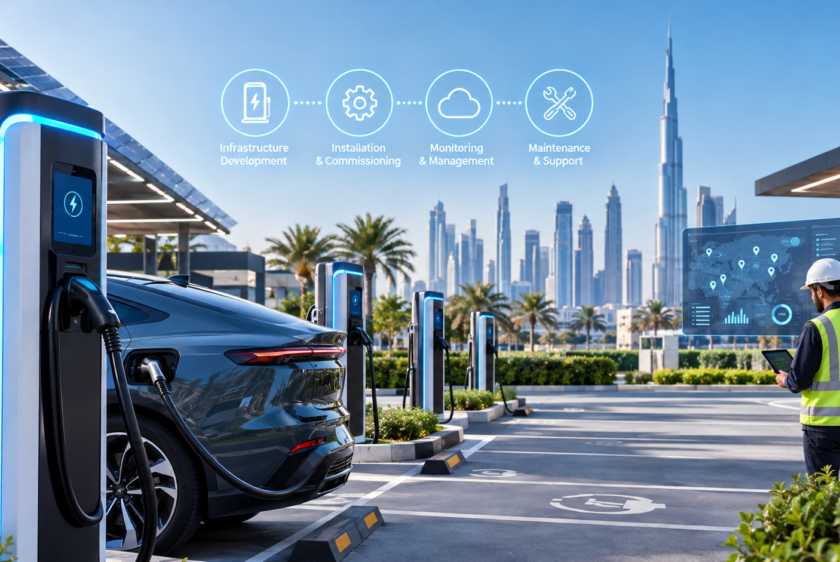
EV Charger Infrastructure Development and Management is becoming increasingly important as electric vehicle adoption grows across the United Arab Emirates. Businesses, commercial property owners, fleet operators, fuel stations, and Charge Point Operators need reliable, scalable, and intelligent charging systems to meet the changing needs of electric mobility. Effective EV charging station development involves much more than installing charging equipment; it requires careful site assessment, electrical infrastructure planning, charger selection, installation, software integration, and long-term maintenance. Similarly, professional EV charging station management helps businesses monitor performance, maintain charging availability, improve operational efficiency, and prepare their networks for future expansion. With a comprehensive approach to EV Charger Infrastructure Development and Management, organizations across Dubai, Abu Dhabi, Sharjah, and the wider UAE can build dependable charging networks that support sustainable transportation and long-term business growth.
1. What Is EV Charger Infrastructure Development and Management?
EV Charger Infrastructure Development and Management refers to the complete process of planning, designing, installing, operating, and maintaining electric vehicle charging infrastructure. It combines physical charging equipment, electrical systems, digital platforms, network connectivity, and technical support to create a reliable charging environment for EV drivers.
As the UAE continues to develop its electric mobility ecosystem, businesses require charging infrastructure that matches their operational needs. A residential building may need convenient AC charging, while a commercial parking facility, highway charging hub, or fleet operation may require high-power DC fast chargers. Selecting the right equipment and planning the supporting infrastructure are essential steps toward achieving dependable performance.
EV charging station development begins with understanding the location, expected charging demand, available electrical capacity, parking arrangements, and future expansion requirements. Once the infrastructure is installed, EV charging station management ensures that chargers remain functional, accessible, and efficient throughout their operational life.
A comprehensive infrastructure strategy can include:
- Site assessment and feasibility: Evaluate the location, parking facilities, electrical capacity, and expected charging demand.
- Charger selection: Identify suitable AC chargers or DC fast chargers according to vehicle requirements and usage patterns.
- Electrical infrastructure planning: Assess power distribution, cabling, protection systems, and potential capacity upgrades.
- Installation and commissioning: Coordinate equipment installation, testing, connectivity, and operational readiness.
- Charging network integration: Connect compatible chargers to suitable software platforms for monitoring and management.
- Ongoing maintenance: Schedule inspections, preventive maintenance, troubleshooting, and technical support.
- Future expansion: Design infrastructure that can accommodate additional charging points as demand increases.
By integrating these activities, EV Charger Infrastructure Development and Management helps businesses avoid disconnected systems and create a more organized approach to electric vehicle charging.
2. Why EV Charging Station Development Is Important in the UAE
The UAE presents growing opportunities for EV charging infrastructure across commercial real estate, hospitality, retail, logistics, workplaces, residential communities, and public transportation. As more drivers consider electric vehicles, convenient access to charging becomes an important factor in the overall ownership and driving experience.
For businesses, EV charging station development can support sustainability objectives, improve customer convenience, and introduce additional services for employees, visitors, tenants, and fleet users. Shopping malls and hotels can provide charging facilities while customers spend time on their premises. Offices can support employees who drive electric vehicles, while fleet operators can establish charging facilities around their daily vehicle schedules.
However, successful EV charging station development requires more than identifying an available parking space. The infrastructure must be designed around actual demand, electrical requirements, charger utilization, and the needs of the people who will use it.
Businesses planning charging stations should consider the following factors:
- Location suitability: Select sites that offer convenient access, appropriate parking, and sufficient space for charging equipment.
- Electrical capacity: Determine whether the existing power supply can support the planned charging load.
- Charging speed: Choose AC charging for suitable longer-duration parking and DC fast charging where faster turnaround is important.
- User requirements: Consider whether the stations will serve employees, residents, customers, public drivers, or commercial fleets.
- Network connectivity: Evaluate communication infrastructure and compatibility with charging management platforms.
- Environmental conditions: Select equipment suitable for the location’s operating conditions, including outdoor heat and dust exposure.
- Expansion potential: Allow for future charging points without unnecessary infrastructure redesign.
Professional planning can help identify potential challenges before equipment is purchased or installation begins. It also supports better coordination among property managers, electrical contractors, equipment suppliers, software providers, and other project stakeholders.
For organizations investing in EV charging station development in Dubai and across the UAE, a carefully planned project creates a stronger foundation for long-term reliability and operational efficiency.
3. How EV Charging Station Management Improves Operational Efficiency
Installing charging stations is only the beginning of a successful EV infrastructure project. Once the chargers become operational, businesses need an effective way to monitor their performance, respond to technical issues, maintain equipment, and manage charging activities. This is where EV charging station management becomes essential.
A well-organized EV charging station management strategy provides operational visibility and helps businesses maintain a consistent charging experience. Depending on the equipment and software platform, operators may be able to monitor charger status remotely, review charging sessions, identify faults, manage user access, and analyze energy consumption.
For businesses operating multiple charging points, centralized management can be particularly useful. Rather than checking every charging station individually, operators can use compatible management software to access relevant operational information through a single platform.
Key EV charging station management activities include:
- Real-time monitoring: Review available charger status and charging activity through supported software.
- Fault detection: Identify reported errors and arrange appropriate technical assistance.
- Preventive maintenance: Schedule inspections and servicing to help reduce avoidable equipment failures.
- Charging-session management: Monitor session information and charging activity where supported.
- Access and user management: Configure access permissions and charging policies according to business requirements.
- Energy monitoring: Review consumption data and identify opportunities to improve energy use.
- Performance reporting: Evaluate charging activity, utilization, recurring issues, and operational trends.
- Technical support: Coordinate troubleshooting, repairs, replacement parts, and maintenance activities.
Open Charge Point Protocol (OCPP) can also play an important role in connected charging networks. OCPP enables communication between compatible charging stations and a central management system. Depending on the implementation, it can support remote monitoring, configuration, and other network-management functions.
Effective EV charging station management can help businesses improve visibility, organize maintenance, and make informed operational decisions. Although no management system can eliminate every fault or guarantee uninterrupted service, a structured approach helps operators respond more systematically when issues arise.
For Charge Point Operators and businesses managing several locations, combining EV Charger Infrastructure Development and Management with appropriate software and technical support helps create a more scalable operating model.
4. Choosing the Right EV Charging Infrastructure for Different Business Needs
Every charging environment has different technical and operational requirements. A solution that works well for a workplace may not be suitable for a busy fuel station or a commercial fleet depot. Therefore, EV charging station development should begin with a clear understanding of how vehicles will use the charging facility.
Newmont Energy provides EV charging solutions for different applications, including homes, workplaces, commercial parking facilities, gas stations, and Charge Point Operators. Its portfolio includes charging hardware and supporting services such as installation, commissioning, maintenance, and technical assistance.
The main applications of EV Charger Infrastructure Development and Management include:
- Commercial properties: Shopping malls, hotels, airports, and public parking facilities can install charging stations to serve customers and visitors. Planning should consider vehicle turnover, parking duration, accessibility, and expected demand.
- Workplaces: Offices and business parks can provide charging facilities for employees and visitors. Smart charging and appropriate power management may help accommodate multiple vehicles.
- Residential communities: Apartment buildings, villas, and residential developments can introduce charging facilities based on parking arrangements, electrical capacity, and resident requirements.
- Gas stations: Fuel stations can expand their services by adding EV charging facilities. DC fast chargers may be appropriate where drivers need quicker charging and site utilization supports the investment.
- Fleet operators: Delivery companies, logistics businesses, and commercial vehicle operators can develop charging infrastructure around vehicle routes, operating schedules, and daily energy requirements.
- Charge Point Operators: CPOs need scalable infrastructure, compatible network-management platforms, technical support, and an operational strategy for managing charging stations across multiple locations.
Before selecting a solution, businesses should assess charger power, expected utilization, installation requirements, electrical capacity, software compatibility, maintenance needs, and total cost of ownership.
For example, a workplace with vehicles parked for several hours may benefit from a carefully planned AC charging installation. A high-traffic public charging location may need DC fast charging to support shorter charging stops. A fleet depot may require a combination of charger types and charging schedules to support operational requirements.
The most effective EV charging station development strategy is therefore one that matches the infrastructure to the intended use rather than simply choosing the highest-powered charger available.
5. Key Steps in EV Charger Infrastructure Development and Management
A successful charging project requires a coordinated process from initial planning through installation and ongoing operation. Each stage influences the project’s cost, technical suitability, operational readiness, and ability to expand in the future.
A structured EV Charger Infrastructure Development and Management process helps businesses make informed decisions and coordinate the various parties involved in implementation.
The typical stages include:
- Step 1: Define project objectives. Establish whether the infrastructure will serve employees, residents, customers, public drivers, or commercial fleets. Determine the expected number of charging points and the intended operating model.
- Step 2: Conduct a site survey. Assess parking layouts, equipment placement, cable routes, existing electrical infrastructure, and practical installation constraints.
- Step 3: Evaluate power requirements. Review the available electrical capacity and estimate the charging load. Identify whether electrical upgrades or suitable load-management measures may be necessary.
- Step 4: Select charging technology. Choose appropriate AC or DC charging equipment based on vehicle requirements, charging duration, utilization, and site conditions.
- Step 5: Plan the infrastructure design. Coordinate electrical work, equipment locations, connectivity, safety measures, accessibility, and potential future expansion.
- Step 6: Coordinate installation. Manage equipment delivery, electrical preparation, installation activities, and communication among contractors and suppliers.
- Step 7: Integrate charging software. Configure compatible chargers and connect them to the selected management platform where required.
- Step 8: Test and commission. Verify installation quality, electrical safety, communication, charging functionality, and operational readiness before handover.
- Step 9: Establish management procedures. Set up monitoring, maintenance schedules, fault reporting, technical support, and performance tracking.
- Step 10: Review and expand. Analyze charging activity and operational needs to determine whether additional chargers, upgraded power capacity, or improved management processes are appropriate.
These stages should be adapted to the size and complexity of each project. A small workplace installation may require a relatively straightforward process, whereas a multi-location charging network needs greater coordination, standardized procedures, and detailed operational planning.
Professional EV charging station development also requires attention to applicable technical requirements, utility approvals, property permissions, and other relevant local regulations. Requirements can vary according to the site and project, so businesses should confirm the applicable approval process before procurement and installation.
By treating charging infrastructure as a complete project rather than an equipment purchase, organizations can improve coordination and establish a clearer path from initial planning to long-term operation.
6. The Future of EV Charging Station Development and Management in the UAE
The future of electric mobility depends not only on the number of electric vehicles on the road but also on the availability, accessibility, and reliability of charging infrastructure. As charging requirements evolve, businesses across the UAE will need solutions that can adapt to changing demand, support connected operations, and accommodate future expansion.
EV Charger Infrastructure Development and Management will remain important for organizations that want to build charging networks around real operational requirements. Well-planned EV charging station development can help create suitable charging locations, while effective EV charging station management supports day-to-day operations and ongoing performance improvement.
Several priorities will shape future charging infrastructure projects:
- Scalable charging networks: Infrastructure should accommodate additional chargers and new locations as requirements grow.
- Connected charging technology: Compatible software platforms and communication protocols can improve visibility and simplify network management.
- Smarter energy use: Load management and energy monitoring can help organizations manage available electrical capacity more effectively.
- Reliable maintenance: Preventive servicing and structured fault response can help reduce avoidable downtime.
- User-focused design: Clear signage, accessible parking arrangements, convenient charger placement, and straightforward charging procedures can improve the driver experience.
- Data-informed decisions: Charging-session records and utilization reports can help businesses assess demand and guide future investments.
- Lifecycle planning: Organizations should consider installation, maintenance, software, energy, and replacement costs rather than focusing only on the initial equipment price.
Businesses should also evaluate how their charging requirements may change over time. A commercial property that initially installs a few chargers may eventually need more charging points. A fleet operator may introduce additional electric vehicles, while a Charge Point Operator may expand into new locations. Infrastructure that anticipates these possibilities can make future development easier, although expansion will still depend on available power, site conditions, and project economics.
Newmont Energy supports EV charging applications across the UAE with charging hardware and services covering different business environments. Its offering includes installation, commissioning, maintenance, spare-parts management, technical training, and partner support, helping address important aspects of charging infrastructure throughout its operational life.
For organizations planning their next charging project, the priority should be to select an approach that balances technical requirements, operating costs, user needs, and future growth. A well-designed infrastructure strategy can help businesses move beyond individual charging installations toward a connected and professionally managed charging network.
Conclusion
EV Charger Infrastructure Development and Management is a key consideration for businesses seeking to support electric mobility in the UAE. Successful EV charging station development requires appropriate site selection, electrical planning, charger selection, professional installation, and commissioning. Meanwhile, EV charging station management helps operators monitor performance, coordinate maintenance, and manage charging networks more effectively.
By combining thoughtful planning, suitable charging technology, compatible management software, and ongoing technical support, organizations can establish charging infrastructure that meets current requirements while remaining adaptable to future needs.
Whether you are developing charging facilities for a commercial property, workplace, gas station, fleet, or public charging network, a comprehensive approach can help simplify implementation and support long-term operational goals.
Newmont Energy offers EV charging solutions and supporting services for different applications across the UAE. Businesses looking to establish or expand their charging infrastructure can explore its solutions at https://evcharger-uae.com/ and identify an approach suited to their site, charging requirements, and future plans.