




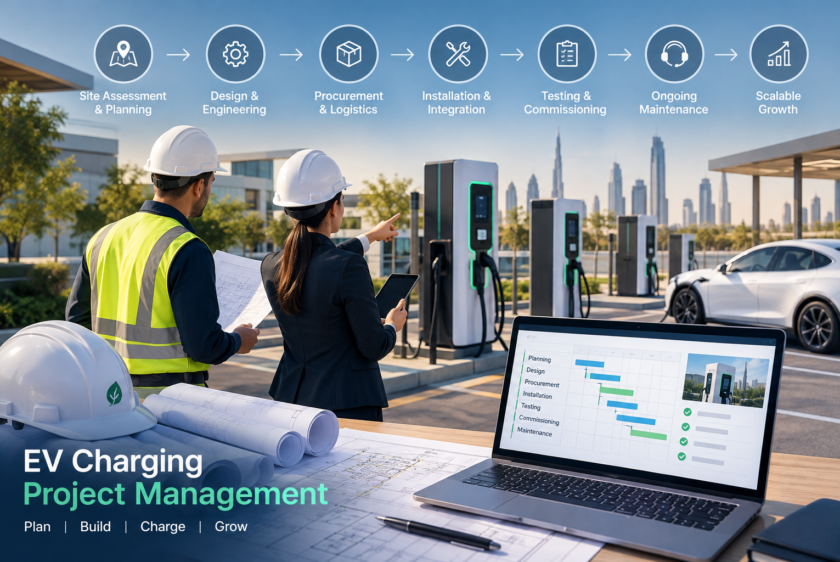
As electric vehicle adoption continues to grow, businesses across the UAE are investing in reliable, scalable, and intelligent charging infrastructure. However, successful deployment requires much more than purchasing and installing charging stations. EV charging project management brings together site assessment, electrical planning, charger selection, installation, software integration, commissioning, maintenance, and long-term network operations into one coordinated process. With professional EV charging project management, businesses can develop charging infrastructure that is safer, more efficient, easier to manage, and prepared for future expansion. Combined with EV charging infrastructure consulting and OCPP charging management, a structured approach can help organizations build dependable EV charging networks that support drivers, fleets, commercial properties, workplaces, and Charge Point Operators across the UAE.
1. What Is EV Charging Project Management?
EV charging project management is the organized process of planning, coordinating, implementing, testing, and maintaining an EV charging infrastructure project. It connects the technical, electrical, commercial, operational, and software requirements of a charging project so that every stage works together efficiently. Instead of treating an EV charger as an individual piece of equipment, project management looks at the entire charging ecosystem, from the first site survey to long-term operation.
For businesses, this approach is particularly important when installing multiple charging points or developing a public, commercial, fleet, workplace, or charging-network environment. Each project can have different requirements based on vehicle usage, parking duration, available electrical capacity, charging speed, connectivity, location, and expected demand.
Professional EV charging project management helps businesses make informed decisions before significant investments are made. A detailed project plan can identify potential infrastructure limitations, determine suitable charger capacities, coordinate different contractors, and establish a realistic implementation schedule.
A successful project may involve:
- Initial site assessment and feasibility study
- Electrical load and infrastructure evaluation
- Charger technology and capacity selection
- Charging station layout and installation planning
- Civil and electrical work coordination
- Equipment procurement and delivery
- Network and communication planning
- OCPP configuration and backend integration
- Installation and testing
- Commissioning and operational handover
- Preventive maintenance and technical support
- Future expansion and infrastructure planning
The advantage of having these activities managed through a structured process is better coordination. Property owners, electrical contractors, charger suppliers, software providers, facility managers, and network operators can work toward the same project objectives rather than handling isolated tasks independently.
This integrated approach is especially valuable in the UAE, where charging infrastructure may need to operate in demanding outdoor environments and support different applications ranging from residential charging to high-utilization commercial and fleet charging.
2. Why EV Charging Infrastructure Consulting Is Essential Before Installation
A charging project should not begin with the question, “Which charger should we buy?” It should begin with, “What charging infrastructure does this location actually require?” This is where EV charging infrastructure consulting becomes important.
EV charging infrastructure consulting provides the technical and strategic assessment required to understand the current site, expected charging demand, electrical requirements, business objectives, and future expansion possibilities. Proper consulting helps prevent businesses from investing in equipment that does not match their actual operational requirements.
For example, an office building where vehicles remain parked for several hours may benefit from AC charging, while a fuel station, public charging hub, or high-utilization fleet operation may require high-power DC fast charging. Newmont Energy’s charging portfolio covers residential, workplace, commercial, gas-station, and Charge Point Operator applications, demonstrating the importance of matching charging technology to the environment.
A professional EV charging infrastructure consulting process can examine:
- Existing electrical capacity
- Transformer and distribution requirements
- Available parking spaces
- Charger positioning
- Vehicle traffic and parking patterns
- Expected charging demand
- AC versus DC charging requirements
- Cable routing and electrical protection
- Network connectivity
- Backend software requirements
- Future charging expansion
- Maintenance and operational requirements
Consulting also helps organizations plan for future growth. Installing a small number of chargers today does not mean the infrastructure should be designed only for today’s demand. Electrical capacity, cable pathways, communication systems, parking layouts, and backend platforms can all influence how easily a charging network can expand later.
For large commercial projects, EV charging infrastructure consulting can therefore become an important investment-protection strategy. It helps organizations understand the complete infrastructure requirement before procurement and installation begin.
A well-designed project should consider both current and future requirements, including:
- Current EV charging demand
- Expected growth in EV adoption
- Future charger additions
- Available electrical capacity
- Operational costs
- Network management requirements
- Maintenance accessibility
- User experience
- Scalability of the charging platform
3. How OCPP Charging Management Makes EV Networks Smarter
Modern EV charging infrastructure is not only about hardware. Software connectivity and remote management are equally important, particularly when a business operates several charging stations. OCPP charging management provides an important foundation for connecting compatible charging stations with charging management platforms.
OCPP, or Open Charge Point Protocol, enables communication between charging stations and backend management systems. Newmont Energy highlights OCPP-compliant charging systems for Charge Point Operators, while its charging equipment supports OCPP-based connectivity for smart charging and network management.
With OCPP charging management, operators can manage charging infrastructure more efficiently instead of relying entirely on physical access to individual charging stations.
Depending on the charging management platform and configuration, businesses can benefit from capabilities such as:
- Remote charger monitoring
- Charging-session visibility
- User authentication
- Energy consumption monitoring
- Fault and error reporting
- Remote configuration
- Tariff and access management
- Fleet reporting
- Backend software integration
- Firmware and software management
- Charging network performance monitoring
OCPP charging management becomes increasingly valuable as the number of charging points grows. A business operating one charger may be able to monitor it manually, but a network containing dozens or hundreds of chargers requires centralized visibility and management.
For Charge Point Operators, OCPP can also support a more scalable network strategy. Newmont Energy specifically provides scalable charging solutions for Charging Network Operators across the UAE and emphasizes OCPP-compliant systems for network management.
The combination of EV charging project management and OCPP charging management creates a connection between the physical and digital sides of an EV charging network. Project management ensures the infrastructure is correctly planned and deployed, while OCPP-based management helps operators monitor and manage the charging network after deployment.
This is increasingly important as EV charging evolves from standalone charging stations into connected, intelligent energy infrastructure.
4. EV Charging Project Management for Different UAE Applications
The requirements of an EV charging project vary significantly depending on where the chargers will be installed and how they will be used. Effective EV charging project management therefore needs to be application-specific rather than based on a one-size-fits-all model.
Newmont Energy’s charging solutions address Charge Point Operators, gas stations, workplaces, commercial properties, and homes across the UAE.
Charge Point Operators
Charge Point Operators require scalable charging infrastructure, reliable network connectivity, and centralized management. EV charging project management can coordinate charger deployment, backend integration, commissioning, maintenance, and network expansion.
Important considerations include:
- Scalable charging architecture
- OCPP compatibility
- Network connectivity
- Centralized monitoring
- Charger uptime
- Maintenance planning
- Future site expansion
Gas Stations
Gas stations can become important EV charging destinations because drivers already associate these locations with refueling and mobility services. High-power DC charging can support faster vehicle turnaround where electrical infrastructure and site conditions allow.
Project planning should consider:
- High charging demand
- Traffic movement
- Charger accessibility
- Electrical capacity
- Safety requirements
- 24/7 operational needs
- Maintenance accessibility
- Future charging demand
Workplaces
Workplace charging is generally focused on vehicles that remain parked for several hours. AC charging and smart charging capabilities can be suitable for many workplace environments.
A workplace project may include:
- Employee charging access
- AC charging stations
- Smart charging
- Load management
- User authentication
- Energy monitoring
- Maintenance support
Commercial Properties
Shopping malls, hotels, airports, public parking facilities, and mixed-use developments can use EV charging as an additional customer service and mobility amenity. Newmont Energy identifies commercial locations such as malls, hotels, airports, and public parking facilities among its charging applications.
Commercial projects may require:
- Multiple charging stations
- AC and DC charging options
- High utilization capability
- User-friendly access
- Network management
- Payment or access integration
- Preventive maintenance
- Future expansion capability
Residential Properties
Homes, villas, apartments, and residential communities have different requirements because vehicles may remain parked for extended periods. The focus is typically on safe, convenient, and reliable charging.
Residential planning can include:
- Site and electrical assessment
- Charger selection
- Installation planning
- Load considerations
- Safety protection
- Smart charging
- Testing and commissioning
- Ongoing technical support
5. Key Stages of Professional EV Charging Project Management
A successful charging network is built through a series of connected stages. Professional EV charging project management ensures that these stages are properly coordinated instead of being treated as separate activities.
The process generally begins with discovery and feasibility. During this stage, the project team evaluates the location, charging requirements, electrical infrastructure, parking arrangements, user requirements, and business objectives.
The next stage involves infrastructure design and technology selection. Charger power, AC or DC technology, communication requirements, connectivity, and future scalability need to be considered before equipment is finalized.
A structured project can include:
- Discovery and site assessment: Understand the physical location, electrical infrastructure, parking, and expected charging demand.
- Infrastructure planning: Determine electrical requirements, charger locations, cabling, protection, and communication infrastructure.
- Technology selection: Choose chargers based on charging speed, vehicle requirements, utilization, environmental conditions, and operational objectives.
- Procurement coordination: Manage equipment availability, delivery schedules, specifications, and project timelines.
- Installation: Coordinate electrical, civil, and charger installation activities.
- Software integration: Connect compatible chargers to the selected charging management platform.
- OCPP configuration: Establish communication between chargers and the backend system where applicable.
- Testing: Verify electrical safety, communication, charging performance, and system functionality.
- Commissioning: Confirm that the charging stations are ready for operational use.
- Handover: Provide operational information, documentation, training, and support.
- Maintenance: Monitor performance and conduct preventive and corrective maintenance.
- Expansion planning: Prepare the infrastructure for additional charging stations as demand grows.
Newmont Energy’s existing service offering includes installation, commissioning, maintenance, spare-parts management, technical training, and partner support, which aligns with the need for lifecycle-focused charging infrastructure rather than one-time hardware installation.
This lifecycle approach is one of the most important aspects of EV charging project management. The project does not end when the charger is switched on. Long-term reliability, maintenance, software management, user experience, and future expansion are equally important.
6. Building a Future-Ready EV Charging Network in the UAE
The UAE’s transition toward electric mobility is creating opportunities for businesses, property developers, fleet operators, Charge Point Operators, workplaces, hospitality businesses, fuel stations, and other organizations to develop charging infrastructure. However, the most successful projects will be those designed around real operational requirements rather than simply adding chargers to available parking spaces.
EV charging project management provides the structure needed to turn an initial charging concept into a functional and scalable infrastructure network. EV charging infrastructure consulting helps organizations understand their technical and strategic requirements before implementation, while OCPP charging management provides the connectivity and centralized management capabilities needed for modern charging networks.
Businesses planning an EV charging project should evaluate:
- Current and future charging demand
- Site and electrical capacity
- Charger power requirements
- AC and DC charging requirements
- Parking and vehicle movement
- Network connectivity
- OCPP compatibility
- Backend management
- Safety and environmental requirements
- Maintenance and technical support
- Future expansion opportunities
- Total project and operational costs
The right approach also depends on the type of charging environment. A workplace may prioritize smart AC charging, while a public charging hub may require high-power DC charging. A fleet operator may prioritize predictable charging schedules and uptime, while a Charge Point Operator may focus on network scalability, centralized management, user access, and operational analytics.
Newmont Energy’s current UAE offering reflects this broad approach, covering charging solutions for homes, workplaces, commercial properties, gas stations, and Charge Point Operators, alongside equipment, installation, commissioning, maintenance, and network-related capabilities.
Ultimately, effective EV charging project management is about creating a charging ecosystem that works today while remaining ready for tomorrow. By combining detailed planning, EV charging infrastructure consulting, appropriate charging technology, professional installation, OCPP charging management, commissioning, maintenance, and future expansion planning, organizations can build charging networks that are reliable, connected, and scalable.
As electric mobility continues to develop across the UAE, businesses that approach charging infrastructure as a complete technology and infrastructure project will be better positioned to deliver convenient charging experiences and support long-term EV adoption. A professionally managed charging project can transform EV charging from a simple equipment installation into a strategic infrastructure investment that supports mobility, business operations, customer experience, and the UAE’s broader transition toward smarter and more sustainable transportation.