




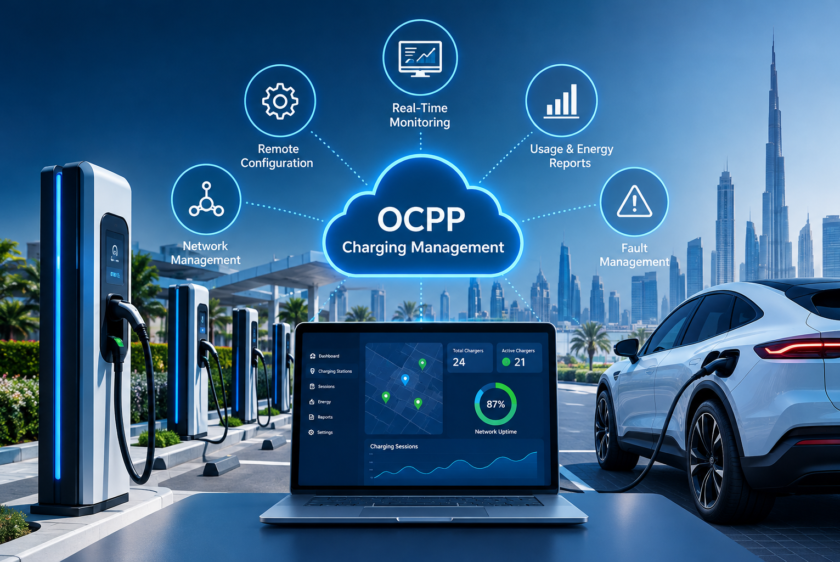
OCPP charging management is becoming an essential part of modern electric vehicle (EV) charging infrastructure as businesses across the UAE invest in connected, reliable, and scalable charging networks. From commercial properties and workplaces to fuel stations, fleet depots, and public charging hubs, effective OCPP charging management helps operators monitor charging stations, coordinate network operations, and improve the overall charging experience. By combining OCPP charging management with EV charging infrastructure consulting and EV charging project management, businesses can develop intelligent charging solutions that support operational efficiency, long-term growth, and the UAE’s transition toward sustainable mobility.
1. What Is OCPP Charging Management and Why Does It Matter?
OCPP stands for Open Charge Point Protocol. It is a communication protocol that enables compatible EV charging stations to communicate with a central charging management system. This connection allows operators to monitor and manage their charging infrastructure through software rather than depending entirely on manual inspections or individual charger controls.
OCPP charging management is particularly valuable for businesses operating multiple charging points or planning to expand their EV charging networks. Instead of treating each charger as an independent unit, operators can manage compatible charging stations through a centralized platform, depending on the software, protocol version, and available features.
For businesses in the UAE, OCPP charging management can support a more organized approach to operating charging infrastructure across commercial buildings, hotels, shopping malls, workplaces, fuel stations, and fleet facilities. It also complements EV charging infrastructure consulting by ensuring that software and communication requirements are considered before installation begins.
Key benefits and capabilities of OCPP charging management include:
- Centralized monitoring: View the operational status of connected charging stations through a compatible management platform.
- Remote management: Perform supported configuration and operational tasks without visiting every charging location.
- Charging session visibility: Review charging activity and session information provided by the connected system.
- Fault monitoring: Identify reported charger errors and help technical teams investigate problems more efficiently.
- Energy usage tracking: Access charging and consumption data where supported by the charger and backend platform.
- Scalable operations: Establish a management framework that can accommodate additional compatible charging stations.
- Software integration: Connect charging infrastructure with supported management platforms and related digital services.
OCPP charging management is not simply a software feature. It is part of a broader strategy for making EV charging networks easier to operate, maintain, and expand. When supported by appropriate hardware and a suitable backend platform, it can help businesses build a more connected charging ecosystem.
2. The Role of EV Charging Infrastructure Consulting in Successful Network Development
Before investing in charging equipment, businesses need to understand their site’s technical requirements, expected charging demand, available electrical capacity, and long-term operational goals. EV charging infrastructure consulting helps bring these considerations together before procurement and installation begin.
Choosing a charger without evaluating the site can result in unsuitable charging speeds, unnecessary infrastructure expenditure, limited expansion opportunities, or compatibility issues. A professional consulting process helps organizations select an appropriate combination of charging hardware, electrical infrastructure, software connectivity, and operational support.
For example, an office building where employees park for several hours may benefit from AC charging, while a busy fuel station or high-utilization fleet location may require DC fast charging. The right solution depends on vehicle requirements, dwell time, power availability, site conditions, and expected usage.
EV charging infrastructure consulting should also address OCPP charging management from the beginning. Businesses need to confirm that their selected charging stations, communication protocol, and backend management software work together as intended.
Important areas to assess during EV charging infrastructure consulting include:
- Site feasibility: Evaluate the available space, parking configuration, accessibility, and suitability of the proposed charging location.
- Electrical capacity: Assess the existing electrical supply and identify any required upgrades or additional infrastructure.
- Charger selection: Determine whether AC chargers, DC fast chargers, or a combination of both will meet the site’s requirements.
- Network connectivity: Review the availability and reliability of suitable internet or cellular connectivity for connected charging stations.
- OCPP compatibility: Confirm the supported OCPP version and compatibility between chargers and the selected backend platform.
- Load management: Evaluate how charging demand can be coordinated with the site’s available electrical capacity.
- Future expansion: Plan cable routes, electrical infrastructure, communication systems, and space for additional charging points.
- Operational planning: Consider maintenance, monitoring, user access, energy reporting, and ongoing technical support.
Effective EV charging infrastructure consulting helps businesses make informed decisions before committing to major investments. It also creates a stronger foundation for EV charging project management by identifying technical requirements, potential risks, and project priorities early.
For organizations developing charging infrastructure in Dubai, Abu Dhabi, Sharjah, and other Emirates, this planning process can help align the proposed charging network with the needs of drivers, property owners, fleet managers, and charging operators.
3. How OCPP Charging Management Improves EV Charging Operations
Once charging infrastructure is installed, maintaining visibility into network performance becomes an important operational responsibility. OCPP charging management can help operators oversee connected charging stations, understand reported faults, review charging activity, and manage supported functions through a compatible backend system.
Without centralized management, businesses operating several charging locations may need to coordinate information from different devices, maintenance teams, and software systems. This can make it harder to identify recurring issues, evaluate charger utilization, and maintain consistent operational standards.
With a suitable OCPP charging management platform, operators can bring more of this information into one management environment. The exact functionality depends on the charger, supported OCPP version, backend software, and configuration.
Key operational advantages can include:
- Improved visibility: Monitor the status of compatible chargers from a central interface.
- Faster troubleshooting: Use available error reports and diagnostic information to help identify operational issues.
- Better maintenance coordination: Use charger status and service records to plan technical interventions.
- Usage analysis: Review charging sessions and utilization data to understand how the infrastructure is being used.
- Operational consistency: Apply supported configuration and management procedures across connected charging stations.
- Network oversight: Manage information from multiple charging locations through a compatible platform.
- Performance evaluation: Use available operational data to identify potential improvements in charger availability and utilization.
Consider a company operating charging stations at several commercial properties. If one charger repeatedly reports communication errors, centralized monitoring can help the operator identify the issue and coordinate technical support. If certain charging stations experience higher demand, usage reports may help the business evaluate whether additional charging points are required.
However, OCPP charging management does not automatically guarantee maximum uptime, lower electricity bills, or compatibility with every charging platform. Those outcomes depend on appropriate equipment, reliable connectivity, system configuration, maintenance practices, and operational decisions.
For this reason, OCPP charging management should be implemented as part of a wider operational strategy rather than treated as a standalone technology purchase.
4. Why EV Charging Project Management Is Essential for OCPP Integration
A successful EV charging network requires more than selecting compatible chargers and connecting them to software. Electrical infrastructure, charger installation, communications, backend configuration, testing, commissioning, and maintenance must all work together.
EV charging project management coordinates these activities from the initial planning stage through deployment and operational handover. It helps ensure that technical decisions, installation schedules, stakeholder responsibilities, and software requirements remain aligned throughout the project.
OCPP charging management should be included in the project plan before equipment is ordered. This allows the project team to verify communication requirements, identify integration dependencies, and confirm that the intended backend system supports the required features.
A structured EV charging project management process typically includes:
- Project discovery: Define the business objectives, intended users, charging locations, and operational requirements.
- Technical planning: Establish charger specifications, electrical requirements, connectivity needs, and software integration requirements.
- Equipment procurement: Confirm product availability, technical compatibility, delivery schedules, and installation requirements.
- Installation coordination: Organize electrical work, charger mounting, cabling, communications, and site preparation.
- OCPP configuration: Configure supported communication settings and connect compatible charging stations to the selected management platform.
- Integration testing: Verify charger communication, charging functionality, reporting, and other required features.
- Commissioning: Confirm that the installation meets the agreed technical and operational acceptance criteria.
- Operational handover: Provide documentation, system information, and guidance for the team responsible for daily operations.
- Maintenance planning: Establish processes for preventive maintenance, fault reporting, troubleshooting, and technical support.
- Expansion planning: Review the infrastructure’s capacity to support additional charging stations or new locations.
Effective EV charging project management also helps reduce coordination problems between equipment suppliers, electrical contractors, software providers, property managers, and charging network operators.
For example, a commercial development may require several charging stations, a backend management platform, user access controls, and energy monitoring. If software integration is considered only after installation, the project may encounter avoidable delays or compatibility problems. Including OCPP charging management in the original project plan helps the team address these requirements earlier.
By combining EV charging infrastructure consulting with EV charging project management, businesses can develop a more coordinated approach that covers both the design of the charging network and its successful implementation.
5. OCPP Charging Management for Commercial Properties, Fleets, Workplaces, and Charge Point Operators
Different charging environments have different operational requirements. A residential installation may prioritize convenience, while a commercial charging hub may need to support high utilization, multiple users, and ongoing network monitoring. OCPP charging management can support these different applications when the chargers and software are appropriately configured.
Newmont Energy’s website presents EV charging solutions for homes, workplaces, commercial locations, gas stations, and Charge Point Operators across the UAE. Its charging solutions include OCPP-compatible systems for network management, making protocol compatibility an important consideration for organizations planning connected charging infrastructure.
Commercial properties: Shopping malls, hotels, airports, and public parking facilities may use EV charging to improve customer convenience and support electric mobility. OCPP charging management can help operators monitor connected chargers and review usage data. EV charging infrastructure consulting helps determine the appropriate charger mix, while EV charging project management coordinates installation and integration.
Workplaces: Offices and business campuses often need charging solutions for employees, visitors, and company vehicles. Depending on the platform, connected charging systems may support user access management, charging reports, and load management. Careful planning helps align charging capacity with parking duration and available electrical supply.
Fleet operators: Delivery companies, corporate fleets, and other commercial vehicle operators need dependable charging schedules and operational visibility. OCPP charging management can provide useful information about charger status and charging sessions, helping fleet managers coordinate charging operations. The suitability of a particular system depends on fleet size, vehicle requirements, backend functionality, and operational schedules.
Fuel stations: Fuel stations expanding into EV charging need to consider site traffic, charging demand, electrical capacity, and the requirements of continuous operation. EV charging project management helps coordinate infrastructure deployment, while OCPP charging management can support remote monitoring of compatible charging stations.
Charge Point Operators: CPOs managing charging stations across several locations need scalable systems for overseeing connected equipment. OCPP compatibility can provide flexibility in selecting suitable charging hardware and backend management systems, although interoperability must be verified for each implementation.
Across these applications, organizations should evaluate the following requirements before choosing an OCPP charging management solution:
- Charger and backend compatibility.
- Support for the required OCPP version and features.
- Reliable communication and connectivity.
- User authentication and access requirements.
- Charging session and energy data availability.
- Payment, billing, or mobile application integration where needed.
- Maintenance arrangements and technical support.
- Scalability for future charging locations.
- Electrical capacity and load management requirements.
- Data security and appropriate system access controls.
Selecting a solution around the needs of the specific application helps businesses avoid unnecessary complexity while building infrastructure that can support future growth.
6. Building a Scalable and Future-Ready EV Charging Network in the UAE
The growth of electric mobility is creating opportunities for businesses across the UAE to invest in charging infrastructure. However, a future-ready network requires more than installing charging equipment. It needs an integrated approach to planning, hardware selection, electrical design, digital connectivity, operations, and long-term maintenance.
OCPP charging management, EV charging infrastructure consulting, and EV charging project management each contribute to a different part of this process. Consulting helps define the right infrastructure, project management coordinates its implementation, and OCPP-based systems provide communication between compatible chargers and backend management platforms.
Businesses planning new charging networks or upgrading existing installations should consider both immediate operational requirements and future expansion.
Important priorities include:
- Scalable infrastructure: Design electrical systems and site layouts with potential future charging demand in mind.
- Open communication standards: Evaluate OCPP compatibility and verify the features supported by the chosen charger and backend platform.
- Appropriate charging technology: Select AC or DC charging according to vehicle needs, parking duration, power availability, and utilization.
- Reliable operations: Establish monitoring, troubleshooting, preventive maintenance, and technical support processes.
- Data-informed decisions: Use available charging and operational data to evaluate utilization and identify opportunities for improvement.
- Energy management: Assess smart charging and load management options to coordinate demand with available electrical capacity.
- Security and access: Apply appropriate access controls, software updates, and cybersecurity practices across connected infrastructure.
- Long-term cost planning: Consider installation, electricity, software, maintenance, and expansion costs when evaluating the investment.
- Professional implementation: Coordinate planning, installation, integration, testing, and commissioning through a structured project process.
Before selecting an OCPP charging management platform, businesses should also confirm the precise version supported by their charging equipment. OCPP 1.6J and OCPP 2.0.1, for example, have different capabilities, and compatibility should not be assumed simply because two products mention OCPP support.
The same principle applies to backend software. Businesses should check whether the required functions, such as remote monitoring, charging session reporting, user management, or payment integration, are supported by both the charger and the selected platform.
For organizations planning EV infrastructure in the UAE, Newmont Energy offers a starting point for exploring charging equipment and solutions for different applications. Businesses can review its charging solutions and discuss their requirements before deciding on a suitable implementation approach.
Ultimately, OCPP charging management helps establish the digital connectivity needed to oversee modern EV charging networks. When combined with thorough EV charging infrastructure consulting and coordinated EV charging project management, it can help businesses develop charging infrastructure that is easier to monitor, maintain, and expand.
As electric mobility continues to evolve, organizations that treat charging infrastructure as a complete operational system—not just a collection of chargers—will be better prepared to meet changing user expectations and future demand. With appropriate planning, compatible technology, professional installation, and ongoing support, businesses can build connected EV charging networks that contribute to a more convenient and sustainable mobility ecosystem across the UAE.
To explore available charging solutions, visit Newmont Energy’s official website: https://evcharger-uae.com/