
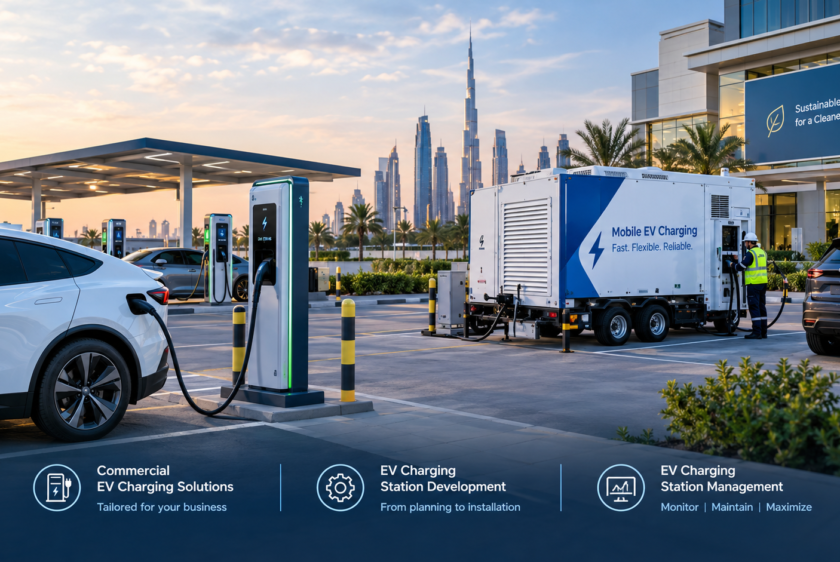
Commercial EV charging solutions are becoming increasingly important as businesses across the United Arab Emirates embrace electric mobility and sustainable transportation. From shopping malls and hotels to corporate offices, logistics centres, airports, and public parking facilities, organizations need reliable charging infrastructure that supports growing electric vehicle demand. Effective Commercial EV charging solutions, EV charging station development, and EV charging station management help businesses establish dependable charging networks, improve customer convenience, support fleet operations, and prepare their facilities for the future of transportation. With flexible charging technologies, smart management systems, and scalable infrastructure, businesses can develop charging facilities that meet their operational requirements while contributing to the UAE’s transition towards cleaner mobility.
1. Understanding Commercial EV Charging Solutions for UAE Businesses
Commercial EV charging solutions include the charging equipment, electrical infrastructure, software, installation services, and operational support required to charge electric vehicles at business and public locations. Unlike residential charging, commercial infrastructure must often accommodate multiple vehicles, varying charging requirements, higher utilization, and continuous operational demands. Businesses need solutions that balance charging speed, reliability, energy consumption, and long-term operating costs.
In Dubai, Abu Dhabi, Sharjah, and other Emirates, commercial properties can benefit from charging infrastructure that is planned around their customers, employees, visitors, and vehicle fleets. A carefully designed charging network can make a property more convenient for EV drivers while creating opportunities for businesses to improve their services.
Newmont Energy provides mobile EV charging solutions designed for situations where rapid deployment, flexible charging access, or limited grid availability makes conventional charging infrastructure challenging. According to its published mobile charging solution specifications, its mobile charging trailer offers 210 kWh of energy storage and DC charging power of up to 180 kW. This can support selected commercial applications, including fleet operations, events, roadside assistance, and infrastructure projects.
Key elements of commercial EV charging solutions include:
- Commercial charging equipment: AC chargers for longer parking periods and DC fast chargers for applications requiring faster charging.
- Scalable charging infrastructure: Systems that can accommodate additional chargers as vehicle demand increases.
- Smart charging technology: Software for monitoring charging activity, managing access, and improving energy utilization.
- Flexible mobile charging: Portable charging capacity for temporary requirements and locations with limited grid access.
- Technical support and maintenance: Services that help maintain charging equipment and reduce avoidable interruptions.
- Integrated project delivery: Coordinated planning, equipment selection, installation guidance, commissioning, and operational support.
Selecting the right commercial EV charging solutions starts with understanding the property, expected charging demand, available electrical capacity, and the needs of the people who will use the chargers.
2. EV Charging Station Development: Planning Reliable Commercial Infrastructure
EV charging station development involves much more than purchasing charging equipment and installing it in a parking space. A successful project requires a structured approach that considers site suitability, electrical infrastructure, charger selection, safety, accessibility, software integration, and future expansion.
For commercial developments in the UAE, the planning stage is especially important because charging infrastructure must suit local operating conditions and the specific requirements of each property. A shopping mall may need charging facilities that serve visitors throughout the day, while a logistics centre may prioritize fleet availability and predictable charging schedules. Hotels and offices may require a combination of charging speeds to accommodate different parking durations.
Professional EV charging station development helps businesses avoid common planning mistakes, including selecting unsuitable charger capacities, overlooking electrical constraints, and failing to account for future charging demand.
The main stages of EV charging station development include:
- Site assessment: Evaluate parking arrangements, vehicle access, installation space, electrical supply, and potential charging demand.
- Infrastructure planning: Determine cable routes, electrical distribution requirements, protection systems, and opportunities for future expansion.
- Charger selection: Choose appropriate AC or DC charging equipment based on vehicle compatibility, parking duration, and operational priorities.
- Installation coordination: Organize the required electrical work, equipment placement, safety measures, and relevant approvals.
- Testing and commissioning: Verify that the installed equipment functions correctly and that charging operations are ready for use.
- Software integration: Connect compatible chargers to charging management platforms for monitoring and operational control.
- Expansion planning: Allow for additional charging points as the number of electric vehicles using the facility grows.
Businesses should also consider how charging infrastructure will operate during peak periods. Load management, suitable equipment sizing, and thoughtful charger placement can help improve efficiency without requiring unnecessary infrastructure upgrades.
For organizations that cannot immediately establish permanent charging facilities at every location, mobile charging can provide an additional option. Newmont Energy’s mobile EV charging solution is designed for rapid deployment without requiring a permanent grid connection at the deployment location. Its suitability depends on the charging demand, operating conditions, and availability of stored energy.
A well-planned development strategy ensures that commercial EV charging solutions meet present requirements while providing a practical foundation for long-term growth.
3. EV Charging Station Management: Improving Performance and Reliability
EV charging station management is essential for maintaining a dependable charging service after installation. Once a charging network becomes operational, businesses need effective ways to monitor charger availability, understand charging activity, coordinate maintenance, and manage energy usage.
Without appropriate management processes, even a well-designed charging installation can experience avoidable downtime, inefficient utilization, and difficulties responding to customer needs. Commercial operators therefore benefit from combining suitable charging hardware with compatible software, clear operating procedures, and ongoing technical support.
For businesses managing several charging points or locations, centralized monitoring can make it easier to understand network performance and identify issues requiring attention. Depending on the selected platform and equipment, management tools may also support user access, charging records, operational reporting, and payment integration.
Important components of EV charging station management include:
- Real-time monitoring: Track charger availability, operating status, and charging sessions where supported by the connected platform.
- Remote diagnostics: Identify certain faults or performance issues without requiring an immediate physical inspection.
- Energy management: Monitor consumption and use compatible load-balancing features to help distribute available electrical capacity.
- Access control: Configure charging access for customers, employees, fleet drivers, or other authorized users.
- Usage reporting: Review charging sessions, energy consumption, and equipment utilization to support operational decisions.
- Preventive maintenance: Schedule inspections and servicing to reduce avoidable equipment failures.
- Technical support: Establish clear procedures for handling charger faults, user concerns, and operational interruptions.
Open Charge Point Protocol (OCPP) can also play an important role in connected charging networks. OCPP supports communication between compatible charging stations and management systems, although actual interoperability depends on the equipment, supported protocol version, and software implementation.
Newmont Energy’s published mobile charging specifications identify OCPP 1.6 communication support. For businesses considering connected commercial EV charging solutions, confirming compatibility between chargers and the intended management platform is an important step.
Effective EV charging station management can help operators improve visibility, coordinate maintenance, and make better use of their charging assets. It also provides a foundation for expanding the network as operational requirements change.
4. Applications of Commercial EV Charging Solutions Across Different Industries
Commercial EV charging solutions can support a wide range of industries across the UAE. However, every business has different requirements, so the charging system should be selected according to vehicle usage, parking duration, site infrastructure, and expected demand.
For example, a hotel may need charging facilities that allow guests to charge while parked overnight, whereas a delivery company may require fast charging to keep vehicles available throughout the working day. A large retail development may benefit from a combination of permanent chargers and flexible charging support during periods of increased demand.
Newmont Energy identifies commercial and public infrastructure, fleet and logistics operations, events, temporary installations, and roadside assistance among the intended applications of its mobile EV charging solution.
Key applications include:
- Shopping malls and retail centres: Provide charging access for customers while they shop, dine, or visit entertainment facilities.
- Hotels and hospitality businesses: Improve convenience for guests and support sustainability initiatives through appropriately planned charging facilities.
- Corporate offices and business parks: Offer workplace charging for employees, visitors, and company vehicles.
- Airports and transport hubs: Explore charging options for selected fleet vehicles, service operations, and suitable parking facilities.
- Logistics and delivery companies: Support fleet electrification through charging infrastructure designed around vehicle schedules and operational requirements.
- Industrial facilities and warehouses: Develop charging facilities for company vehicles and suitable electric transport equipment.
- Events and exhibitions: Use mobile charging where temporary demand or limited permanent infrastructure makes flexible deployment useful.
- Roadside assistance providers: Consider mobile charging for specific situations where an EV needs additional energy to continue its journey.
For commercial property owners, EV charging can also become a valuable part of the overall customer experience. Drivers increasingly appreciate facilities that make charging convenient while they complete other activities.
The best approach is to assess the purpose of each installation before choosing equipment. Commercial EV charging solutions should reflect actual usage patterns rather than relying on a one-size-fits-all design.
5. Benefits of Integrated EV Charging Station Development and Management
Combining EV charging station development with effective EV charging station management gives businesses a more complete approach to electric mobility. Planning, installation, software, and ongoing maintenance work together to determine whether a charging network can deliver reliable service over time.
When these elements are coordinated, organizations can make better-informed investment decisions, simplify operations, and prepare for future charging demand. The benefits depend on the installation, equipment, usage levels, electricity costs, and management capabilities, so businesses should evaluate each project individually.
Important benefits include:
- Improved customer experience: Convenient charging facilities can make commercial properties more attractive to EV drivers.
- Operational efficiency: Smart charging and appropriate load management can help businesses use available electrical capacity more effectively.
- Better asset visibility: Connected monitoring tools can help operators understand charger status and utilization.
- Reduced avoidable downtime: Preventive maintenance and timely fault detection can help address certain issues before they cause prolonged interruptions.
- Scalable infrastructure: Modular planning can make future expansion easier when charging demand increases.
- Support for fleet electrification: Suitable charging systems can help businesses organize vehicle charging around daily operating schedules.
- Sustainability support: Charging infrastructure can contribute to broader electric mobility and environmental objectives, particularly when paired with cleaner electricity.
- Potential commercial opportunities: Charging facilities may support customer engagement, additional services, and new business models, depending on the location and operating strategy.
Businesses should evaluate both initial investment and long-term operational expenses. These can include charging equipment, electrical upgrades, installation, software subscriptions, energy consumption, maintenance, and any applicable network or payment fees.
Mobile charging may also provide flexibility for selected applications. Instead of building permanent infrastructure for every temporary requirement, businesses can evaluate whether a mobile system is appropriate for events, remote operations, emergency support, or short-term demand. However, mobile charging has finite stored energy and must be managed according to its capacity, recharge arrangements, and operational schedule.
Integrated commercial EV charging solutions help businesses connect infrastructure planning with day-to-day performance. This creates a more consistent approach to maintaining charging availability and adapting to changing operational needs.
6. Choosing the Right Commercial EV Charging Partner in the UAE
Selecting the right provider is an important part of successful commercial EV charging solutions. Businesses should look beyond charger specifications and evaluate the provider’s ability to support the broader charging project, from understanding site requirements to equipment integration and after-sales service.
A suitable partner should be able to explain which charging technologies fit the intended application, what infrastructure may be required, and how the proposed solution can be managed after deployment. Clear communication about compatibility, technical limitations, maintenance responsibilities, and ongoing costs is essential.
For companies developing charging infrastructure in Dubai and across the UAE, local operating conditions also matter. High temperatures, dust, outdoor exposure, and intensive use can influence equipment selection and maintenance requirements.
Before choosing a commercial EV charging provider, consider the following:
- Technical suitability: Confirm that the proposed chargers match the vehicles, charging standards, power requirements, and expected usage.
- Site planning expertise: Ensure that the provider can help identify infrastructure requirements and coordinate the appropriate installation process.
- Management capabilities: Review monitoring, reporting, access management, and OCPP compatibility where applicable.
- Environmental suitability: Check equipment operating-temperature limits, protection ratings, cooling systems, and installation requirements.
- Maintenance and support: Understand warranty terms, servicing arrangements, troubleshooting procedures, and access to technical assistance.
- Future scalability: Determine whether the system can accommodate additional chargers or new locations as demand grows.
- Transparent costs: Review equipment, installation, electrical upgrades, software, maintenance, and other recurring expenses.
- Compliance and safety: Confirm that the project follows applicable UAE requirements and that installation work is handled by appropriately qualified professionals.
Newmont Energy, a division of Newmont Trading LLC, offers EV charging solutions for different business and driver requirements. Its mobile EV charging offering is particularly relevant to organizations evaluating flexible, high-power charging for commercial parking, fleet operations, events, roadside assistance, and locations where permanent grid access is limited.
Businesses can explore the Mobile EV Charging Solutions page to review the published capabilities and intended applications of the mobile charging system.
The right commercial EV charging strategy should align technology, infrastructure, and management with the business’s actual requirements. A carefully evaluated solution can help organizations establish dependable charging services while maintaining flexibility as electric mobility develops across the UAE.
As the market evolves, Commercial EV charging solutions, EV charging station development, and EV charging station management will remain important considerations for businesses seeking to support electric vehicles, improve customer convenience, and develop future-ready charging infrastructure. By investing in appropriate planning, suitable equipment, connected management, and ongoing technical support, UAE businesses can take practical steps towards a more accessible and efficient electric mobility ecosystem.