
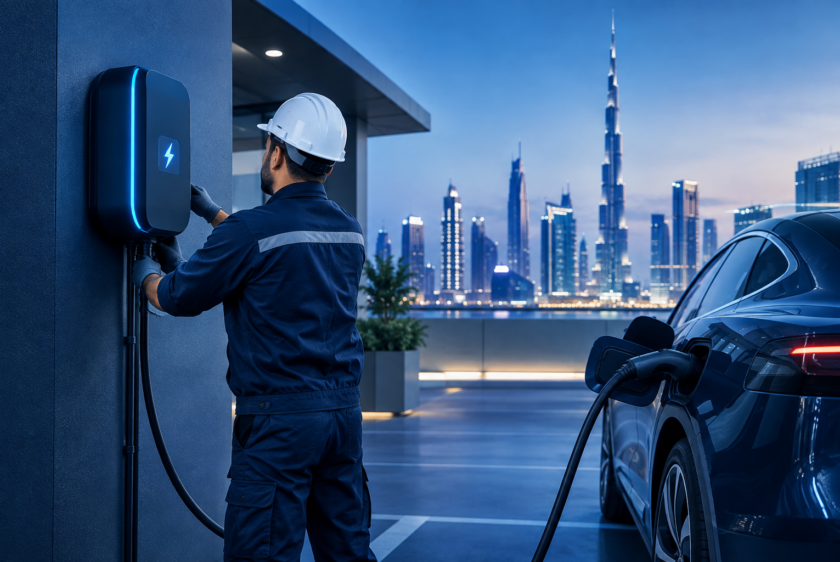
Electric vehicle ownership is growing rapidly across the UAE, increasing demand for reliable charging facilities at villas, residential buildings, offices, hotels, shopping centres, fleet depots and public parking areas.
However, installing an EV charger involves much more than purchasing the equipment and connecting it to an electrical panel. The charger must be compatible with the vehicle, suitable for the available electrical capacity and installed in accordance with the requirements of the relevant electricity, municipality, civil defence and transport authorities.
This guide explains how to choose an EV charger, the usual installation process and the authorities that may be involved in each emirate.
Understanding the Main Types of EV Chargers
EV chargers are generally divided into AC and DC charging systems.
AC EV Chargers
AC chargers supply alternating current to the vehicle, which is converted into DC power by the vehicle’s onboard charger.
Common AC charger ratings include:
- 3.7 kW
- 7.4 kW
- 11 kW
- 22 kW
- Dual-output 22 kW × 2 chargers
AC chargers are normally suitable for villas, apartments, offices, hotels and locations where vehicles remain parked for several hours.
A higher charger rating does not automatically mean that the vehicle will charge at that speed. For example, a vehicle with an 11 kW onboard charger will normally accept only around 11 kW from a 22 kW AC charging point.
DC Fast Chargers
DC chargers convert the electricity inside the charging station and supply DC power directly to the vehicle’s battery.
Common capacities include:
- 30–40 kW portable DC chargers
- 60 kW DC chargers
- 120 kW DC chargers
- 180 kW dual-output chargers
- 240–360 kW high-power chargers
- Megawatt charging systems for selected heavy vehicles
DC chargers are mainly used at fleet depots, petrol stations, highway locations, shopping centres, commercial charging hubs and other sites requiring a short charging time.
How to Select the Right EV Charger
Before selecting a particular brand or charger capacity, consider the following points.
- Identify the Vehicles That Will Use the Charger
Check the charging specifications of the vehicles, including:
- AC onboard charging capacity
- Maximum DC charging capacity
- Charging connector
- Battery capacity
- Voltage platform
- Number of vehicles
- Daily kilometres travelled
- Time available for charging
Type 2 is the most common AC connector used in the UAE. CCS2 is widely used for DC charging, although CHAdeMO may still be required for certain older Japanese vehicles.
For a mixed fleet or public location, connector compatibility should be confirmed before placing the order.
- Check the Available Electrical Load
The electrical load study is one of the most important parts of an EV charging project.
A qualified electrical contractor should check:
- Existing connected load
- Maximum demand
- Spare electrical capacity
- Main distribution board rating
- Transformer capacity
- Cable route and distance
- Earthing arrangement
- Possibility of future expansion
A site may have space for several chargers but insufficient electrical capacity to operate all of them simultaneously.
Where additional capacity is limited or expensive, dynamic load management can distribute the available power between several chargers without exceeding the approved site demand.
- Match the Charger to the Parking Duration
| Location | Typical requirement | Suggested charger |
| Private villa | Overnight charging | 7.4 kW or 11 kW AC |
| Apartment building | Resident charging | 7.4–22 kW AC with access control |
| Office | Four to eight hours of parking | 11 kW or 22 kW AC |
| Hotel or mall | Mixed-duration parking | AC chargers plus selected DC chargers |
| Taxi or limousine fleet | Quick vehicle turnaround | 120–240 kW DC |
| Delivery fleet | Scheduled depot charging | AC or DC, based on duty cycle |
| Public charging hub | High utilisation | 180–360 kW DC with dual outputs |
The correct charger is the one that meets the operational requirement without unnecessarily increasing the project’s electrical infrastructure cost.
- Confirm Communication and Software Compatibility
For commercial and public installations, the charger should support an open communication protocol such as OCPP.
OCPP compatibility allows the charging equipment to communicate with a Charging Point Management System for:
- User authentication
- Tariff management
- Remote monitoring
- Fault reporting
- Energy consumption records
- Mobile-app integration
- Payment processing
- Fleet reporting
- Remote firmware updates
For future flexibility, buyers should confirm that the charger is not permanently locked to one software provider.
- Select Equipment Suitable for UAE Conditions
Outdoor EV chargers in the UAE must withstand heat, dust, humidity and direct sunlight.
Important considerations include:
- Suitable rated operating temperature
- Automatic power derating at high temperatures
- IP-rated protection against dust and water
- UV-resistant enclosure
- Corrosion protection
- Cable and connector temperature monitoring
- Efficient ventilation or liquid cooling
- Availability of spare parts in the UAE
The charger’s quoted maximum output should be reviewed together with its performance under high ambient temperatures.
- Review Electrical and Safety Compliance
The charger and installation should comply with the standards requested by the local authority and project consultant. Depending on the charger and installation, this may include applicable IEC standards for conductive charging, connectors, protection and electromagnetic compatibility.
The electrical design should normally consider:
- Dedicated circuit protection
- Short-circuit and overload protection
- Residual-current and DC leakage protection
- Surge protection
- Emergency isolation
- Earthing and bonding
- Impact protection or bollards
- Fire-safety provisions
- Warning and operating signage
The exact protection arrangement must be selected by a qualified electrical engineer based on the charger manufacturer’s instructions and the local authority’s regulations.
- Evaluate Warranty and Local Support
A low purchase price can become expensive if technical support, replacement parts or trained technicians are unavailable.
Before purchasing, confirm:
- Product warranty period
- Installation warranty
- Preventive-maintenance requirements
- Response time for breakdowns
- Spare-parts availability
- Remote technical support
- Software licence or annual subscription
- Charger uptime commitment
- Availability of authorised technicians
- Warranty conditions for the power modules and charging cables
For commercial DC chargers, a three-to-five-year warranty or service arrangement is strongly recommended.
EV Charger Authority Approvals in Different UAE Emirates
The approval process depends on the emirate, site ownership, electrical account, charger capacity and whether charging will be offered privately or commercially.
Dubai
The principal electricity authority is the Dubai Electricity and Water Authority (DEWA).
DEWA has established a dedicated regulatory and licensing framework for EV charging infrastructure in Dubai. Commercial and public charging projects may require technical approval, connection approval and compliance with the relevant operator-licensing requirements. See the official DEWA Regulatory Framework for EV Charging Infrastructure.
Depending on the project, additional parties may include:
- Dubai Municipality
- Dubai Civil Defence
- Roads and Transport Authority
- Building owner or owners’ association
- Master developer
- Community management
- Licensed charging point operator
- DEWA-approved electrical contractor or consultant
A charger installed in a villa, office or apartment building should not be connected without checking the available load, property permission and DEWA requirements.
A public charger that collects payment is different from a private charger used only by a property owner, tenant, employee or company fleet. Public charging may require additional operating, metering, billing and tariff approvals.
Abu Dhabi and Al Ain
The energy sector in Abu Dhabi is regulated by the Abu Dhabi Department of Energy. Electricity distribution services are provided through TAQA Distribution, following the consolidation of the former Abu Dhabi and Al Ain distribution operations.
Depending on the project, approvals or coordination may involve:
- Department of Energy
- TAQA Distribution
- Department of Municipalities and Transport
- Abu Dhabi Mobility
- Relevant municipality
- Abu Dhabi Civil Defence Authority
- Building owner, developer or property manager
The Department of Energy provides licensing services for regulated energy activities through its digital energy-services platform. More information is available from the Abu Dhabi Department of Energy.
Private and commercial chargers should be declared during the electrical design and load-approval process. Public paid charging stations may require further licensing and operating approval.
Sharjah
Electricity services in most of Sharjah are managed by the Sharjah Electricity, Water and Gas Authority (SEWA).
The usual process may include:
- Property-owner or landlord NOC
- Electrical load assessment
- Single-line diagram and load schedule
- Submission through an approved consultant or contractor
- SEWA load or connection approval
- Municipality approval where civil work is involved
- Civil Defence approval where applicable
- Testing and inspection before energisation
SEWA is the primary utility authority for electricity connections within its service area. Project requirements should be confirmed directly with SEWA because the process can differ between a private wallbox, a building modification and a public charging facility.
Certain Sharjah areas may fall under another electricity-service provider, so the electricity bill and site jurisdiction should always be checked first.
Ajman
Electricity services in Ajman are generally provided by Etihad Water and Electricity (EtihadWE).
A typical commercial installation may require:
- Site-owner NOC
- Load-availability confirmation
- Electrical drawings
- Addition or modification of connected load
- EtihadWE drawing approval
- Municipality approval
- Civil Defence approval, if applicable
- Inspection and energisation
EtihadWE provides services for drawing approval, load addition or modification and new electricity connections through its official portal. These services are described on the EtihadWE website.
Ras Al Khaimah
EtihadWE provides electricity services across much of Ras Al Khaimah. Depending on the specific development, additional coordination may be required with:
- Ras Al Khaimah Municipality
- Relevant free-zone or economic-zone authority
- Master developer
- Civil Defence
- Property management
The electricity account should be checked before starting the design because certain developments may have their own utility-management or approval procedures.
Fujairah
Electricity approvals in Fujairah are generally handled through EtihadWE.
The normal process may involve:
- Electrical load study
- EtihadWE drawing or load approval
- Fujairah Municipality approval
- Civil Defence approval
- Landlord, developer or free-zone NOC
- Inspection and connection
Projects inside Fujairah Free Zone or another specially managed development may also require approval from the relevant zone authority.
Umm Al Quwain
EtihadWE is generally the electricity-service provider in Umm Al Quwain.
Private and commercial installations may require:
- Property-owner approval
- Electrical design and load calculation
- EtihadWE approval for drawings or additional load
- Municipality approval
- Civil Defence approval, where applicable
- Final testing and inspection
Public charging stations may be subject to additional business, payment, tariff and operating requirements.
Typical EV Charger Installation Process
A professionally managed EV charging project normally follows these stages:
Step 1: Site Survey
The contractor inspects the proposed parking area, electrical room, distribution board, transformer, cable route and communication availability.
Step 2: Electrical Load Study
The available load is compared with the proposed charger capacity. The engineer then determines whether the project can use the existing supply or requires a load upgrade, new feeder, transformer or load-management system.
Step 3: Charger Selection
The charger is selected based on the vehicle, charging time, available power, number of users, operating environment and software requirements.
Step 4: Design and Authority Submission
The consultant or approved contractor prepares the necessary documents, which may include:
- Single-line diagram
- Load schedule
- Charger datasheet
- Equipment layout
- Cable calculations
- Earthing details
- Protection coordination
- Civil and foundation drawings
- Parking and traffic layout
- Fire and life-safety documents
- Method statement and risk assessment
Step 5: Obtain NOCs and Approvals
Approvals may be required from the electricity authority, landlord, owners’ association, master developer, municipality, Civil Defence, transport authority or free-zone authority.
Step 6: Civil and Electrical Installation
The work may include:
- Concrete foundation
- Trenching and reinstatement
- Cable pulling
- Distribution-board modification
- Protection devices
- Earthing system
- Network connection
- Charger mounting
- Wheel stops, bollards and signage
Step 7: Testing and Commissioning
The contractor tests insulation, continuity, earthing, protection devices, emergency stop, charger communication and actual vehicle charging.
Step 8: Inspection and Handover
Where required, the relevant authority inspects the installation. The customer should receive test reports, approved drawings, warranties, user instructions and maintenance schedules.
Documents Commonly Required for Approval
Although requirements vary, the following documents are frequently requested:
- Emirates ID or company trade licence
- Tenancy contract or title deed
- Electricity account details
- Property-owner or landlord NOC
- Owners’ association or developer NOC
- Site plan and parking layout
- Existing and proposed load schedule
- Single-line electrical diagram
- Charger technical datasheet
- Compliance certificates
- Cable-sizing and voltage-drop calculations
- Earthing and protection details
- Contractor and consultant licences
- Method statement
- Risk assessment
- Civil Defence documents, where applicable
Common Mistakes to Avoid
Buying the Charger Before Completing a Load Study
The selected charger may be too large for the available electrical supply, resulting in additional infrastructure costs or approval delays.
Selecting Power Based Only on the Charger’s Rating
A 22 kW charger will not provide 22 kW if the vehicle’s onboard charger accepts only 7.4 or 11 kW.
Ignoring Software and Network Charges
Commercial chargers may involve annual software fees, SIM charges, payment-gateway fees, maintenance contracts and CPO-related costs.
Installing Without Property Permission
Apartment, office and commercial-property installations normally require written approval from the building owner, management or owners’ association.
Using a Charger Without Local Technical Support
Long repair times can significantly affect fleet operations and commercial-charging revenue.
Assuming One Approval Applies Across the UAE
Each emirate has its own utility and administrative process. Even within the same emirate, a free zone, master development or privately managed community may impose additional requirements.
Final Recommendation
The best EV charger is not necessarily the charger with the highest power rating. It is the charger that matches:
- The vehicle’s charging capability
- The site’s available electrical load
- The daily operating requirement
- The local authority’s technical requirements
- The expected number of users
- The planned business or billing model
- The required warranty and maintenance support
- Future expansion requirements
A proper site survey and load assessment should therefore be completed before purchasing the equipment.
Newmont Energy can support residential, commercial and fleet customers with charger selection, site surveys, electrical load studies, authority coordination, installation, testing, commissioning, charging-management software and maintenance across the UAE.
Disclaimer: Authority procedures, fees, tariffs and technical requirements may change. The final approval route must be confirmed with the relevant utility, municipality, property authority and other applicable regulators before procurement or installation.