
By Newmont Energy – EV Charging Solutions UAE
When people think about electric vehicles (EVs), Norway is often the first country that comes to mind. With nearly every new passenger vehicle sold being fully electric, Norway has become the global benchmark for sustainable transportation.
However, a new and unexpected player is rapidly emerging in the electric mobility landscape—Ethiopia.
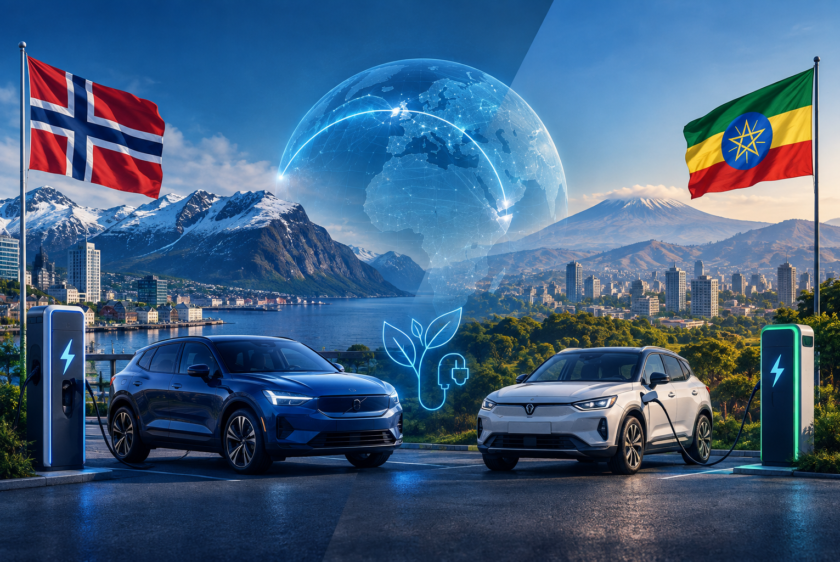
Although these two countries differ greatly in geography, economy, and population, they share a common vision: reducing dependence on fossil fuels and creating a cleaner, more sustainable future through electric mobility.
Norway: The World’s EV Success Story
Norway has spent more than a decade building one of the world’s most successful electric vehicle ecosystems. Today, over 95% of all new passenger cars sold in Norway are fully electric, supported by a comprehensive charging network and strong government policies.
This remarkable achievement was not accidental. It was made possible through:
- Long-term government commitment
- Tax exemptions for EV buyers
- Extensive public charging infrastructure
- Lower ownership costs compared to petrol and diesel vehicles
- Strong public confidence in EV technology
The result is a transport sector that is steadily moving toward zero emissions while reducing dependence on imported fossil fuels.
Norway has demonstrated that when governments, businesses, and infrastructure providers work together, large-scale electrification becomes achievable.
Ethiopia: Africa’s Fastest Growing EV Market
While Norway represents a mature EV market, Ethiopia is writing an entirely different success story.
In recent years, Ethiopia has introduced one of Africa’s most ambitious electric mobility strategies. The country has restricted the import of new fossil-fuel-powered passenger vehicles and is aggressively promoting electric transportation powered by its abundant renewable energy resources.
What makes Ethiopia unique is its energy mix.
More than 90% of the country’s electricity is generated from renewable sources—primarily hydropower—making electric vehicles genuinely clean from generation to the road.
The Ethiopian Government’s E-Mobility Strategy 2025–2030 includes ambitious goals such as:
- Developing a nationwide EV charging network
- Expanding public fast-charging stations
- Electrifying public transportation
- Supporting private investment in charging infrastructure
- Encouraging local EV assembly and manufacturing
- Deploying hundreds of thousands of electric vehicles by 2030
For Africa, Ethiopia is becoming what Norway has been for Europe—a demonstration that government policy and infrastructure investment can rapidly transform transportation.
What These Two Countries Teach the World
Although Norway and Ethiopia are vastly different economies, they share several important lessons:
- Infrastructure Comes First
Consumers adopt electric vehicles only when charging is reliable and accessible.
Public fast chargers, destination chargers, fleet charging stations, and home charging solutions all play a vital role in accelerating EV adoption.
- Government Policy Matters
Tax incentives, import regulations, infrastructure investment, and supportive legislation create confidence for both consumers and investors.
- Renewable Energy Maximizes EV Benefits
Electric vehicles deliver their greatest environmental and economic benefits when powered by clean electricity.
Norway relies heavily on hydropower, while Ethiopia is leveraging one of Africa’s largest renewable energy resources to support its transport transition.
- Private Sector Participation is Essential
Governments can establish policy, but companies must build, install, maintain, and operate the charging infrastructure that keeps EVs moving.
What This Means for the Middle East
The Gulf region is entering its own electric mobility revolution.
Countries such as the UAE and Saudi Arabia are investing heavily in clean transportation, smart cities, renewable energy, and charging infrastructure.
Dubai’s ambitious sustainability initiatives, combined with increasing EV adoption across the region, present enormous opportunities for businesses, developers, fleet operators, and public-sector organizations.
As EV numbers continue to rise, the demand for reliable charging solutions will grow just as rapidly.
Newmont Energy: Supporting the UAE’s Electric Future
At Newmont Energy, we believe that charging infrastructure is the backbone of electric mobility.
We provide complete EV charging solutions for:
- Commercial developments
- Hotels and hospitality
- Shopping malls
- Fleet operators
- Corporate offices
- Residential communities
- Government projects
- Industrial facilities
Our portfolio includes AC chargers, ultra-fast DC chargers, mobile charging solutions, intelligent charging management, installation services, and ongoing maintenance support—helping organizations prepare for the next generation of transportation.
The Road Ahead
Norway has proven that widespread EV adoption is possible.
Ethiopia has shown that even emerging economies can leapfrog traditional transport systems by embracing renewable energy and electric mobility.
Together, these two nations demonstrate that the future of transportation is not limited by geography or economic status—it is driven by vision, infrastructure, and commitment.
As the UAE accelerates its own transition toward sustainable transportation, companies investing in EV charging infrastructure today will be best positioned for tomorrow.
Newmont Energy is proud to be part of this journey—powering the future, one charger at a time.