
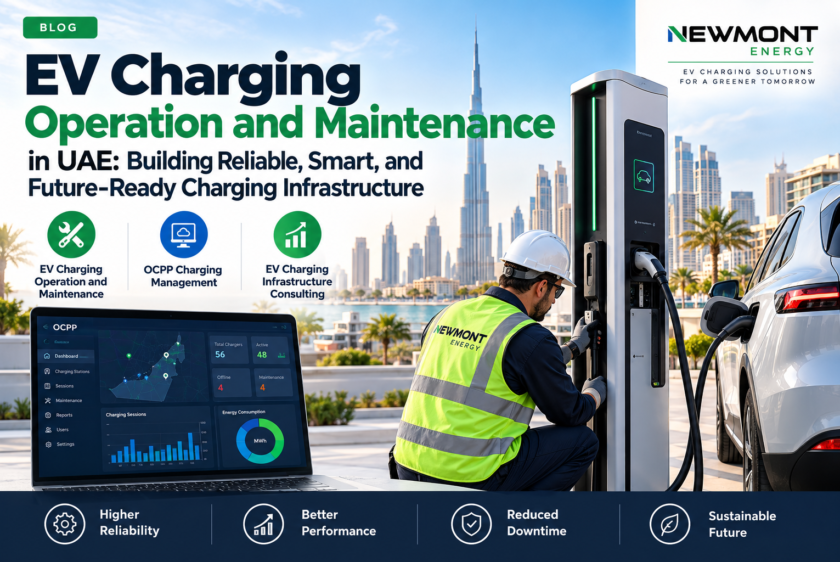
EV charging operation and maintenance is essential for ensuring that electric vehicle charging stations remain safe, efficient, reliable, and ready to support the growing demand for electric mobility across the UAE. As electric vehicles become increasingly common in Dubai, Abu Dhabi, Sharjah, and other Emirates, businesses, property developers, fleet operators, and charging network providers must look beyond installation and focus on long-term charging performance. Professional EV charging operation and maintenance, combined with OCPP charging management and EV charging infrastructure consulting, helps organizations monitor charging networks, minimize avoidable downtime, improve operational efficiency, and prepare their infrastructure for future expansion. Whether managing a commercial charging hub, workplace charging facility, residential development, or public EV charging network, a structured maintenance and management strategy is vital for delivering a dependable charging experience.
1. Why EV Charging Operation and Maintenance Is Essential for Reliable Charging Infrastructure
The rapid development of electric mobility is transforming transportation infrastructure throughout the United Arab Emirates. Businesses are increasingly recognizing the importance of providing convenient charging facilities for employees, customers, residents, and commercial fleets. However, installing charging equipment is only the beginning of building a successful EV charging ecosystem.
EV charging operation and maintenance plays a critical role in ensuring that charging stations continue to function effectively after installation. Without proper maintenance, charging equipment may experience unexpected failures, communication problems, connector damage, overheating, and reduced operational availability. These issues can inconvenience EV drivers and increase operating costs for infrastructure owners.
A comprehensive EV charging operation and maintenance strategy involves regular equipment inspections, preventive servicing, electrical safety assessments, performance monitoring, software maintenance, and timely technical support. These activities help charging station operators identify potential issues before they develop into significant operational problems.
In the UAE, environmental conditions make professional maintenance particularly important. High temperatures, airborne dust, humidity, and prolonged outdoor exposure can affect the performance of charging equipment. Charging stations installed in commercial parking facilities, petrol stations, public areas, and outdoor charging hubs require suitable environmental protection and maintenance procedures.
Effective EV charging infrastructure consulting helps businesses understand these operational challenges before investing in charging equipment. By evaluating environmental conditions, electrical capacity, expected utilization, and maintenance requirements, consultants can help organizations select charging systems that are suitable for their specific locations.
OCPP charging management further strengthens charging operations by connecting compatible charging stations to centralized management platforms. This enables operators to access operational information, identify reported faults, and coordinate maintenance activities more efficiently.
Key benefits of professional EV charging operation and maintenance include:
- Improved charging reliability: Routine inspections and preventive servicing help reduce avoidable equipment failures and operational interruptions.
- Enhanced electrical safety: Regular safety assessments help identify damaged cables, loose connections, insulation issues, and other electrical risks.
- Reduced unexpected downtime: Early identification of equipment problems supports faster troubleshooting and maintenance planning.
- Better equipment performance: Proper servicing helps charging stations operate according to their intended technical specifications.
- Extended equipment service life: Appropriate maintenance can reduce unnecessary wear and support the long-term usability of charging assets.
- Improved user satisfaction: Reliable charging facilities provide a more convenient experience for EV drivers.
- Operational cost control: Planned maintenance can reduce the financial impact of preventable failures and emergency repairs.
- Scalable network management: Structured operational processes make it easier to manage additional charging locations as infrastructure expands.
For organizations investing in electric mobility, EV charging operation and maintenance should be considered a long-term business requirement rather than an occasional technical service. Combining preventive maintenance with OCPP charging management and professional EV charging infrastructure consulting creates a stronger foundation for reliable charging infrastructure.
2. How OCPP Charging Management Improves EV Charging Operation and Maintenance
Modern EV charging networks depend on more than electrical equipment. Digital communication, software connectivity, performance monitoring, and centralized management are increasingly important for maintaining reliable charging services.
This is where OCPP charging management becomes valuable.
OCPP stands for Open Charge Point Protocol, an open communication protocol designed to enable compatible EV charging stations to exchange information with central charging management systems. Through OCPP charging management, charging network operators can oversee connected equipment and access supported operational functions without relying entirely on manual inspections.
For businesses managing multiple charging stations, OCPP charging management can simplify everyday operations. Instead of monitoring each charging point separately, operators can use a compatible centralized platform to review charging status, analyze charging sessions, investigate reported errors, and coordinate technical support.
When integrated with EV charging operation and maintenance, OCPP charging management supports a more proactive approach to equipment servicing.
For example, consider a commercial property operating several EV chargers across multiple parking levels. If one charging station begins reporting repeated communication failures, a connected management system may help the operator identify the issue remotely. Maintenance personnel can then investigate the reported fault and determine whether the problem involves connectivity, configuration, software, or physical equipment.
This approach can improve troubleshooting efficiency and help maintenance teams prioritize urgent operational issues.
However, OCPP charging management capabilities depend on the charging hardware, protocol version, backend software, and system configuration. Businesses should verify compatibility before purchasing equipment or selecting a charging management platform.
Important features and benefits of OCPP charging management include:
- Centralized charger monitoring: Monitor compatible charging stations through a connected management platform.
- Remote fault identification: Receive supported error information and diagnostic reports to assist troubleshooting.
- Charging session monitoring: Review charging activity, session history, and operational data where available.
- Energy consumption visibility: Access supported energy measurements to understand charging demand and utilization.
- Remote configuration: Adjust supported charger settings without requiring physical access to every device.
- User access management: Manage charging permissions and authentication through compatible software.
- Maintenance coordination: Use operational alerts and equipment information to support preventive and corrective maintenance.
- Network performance analysis: Evaluate charger utilization, availability, and recurring technical problems.
- Software management: Support applicable remote software or firmware operations when enabled by the charger and backend system.
- Infrastructure scalability: Create a more consistent management approach as charging networks expand.
OCPP charging management is particularly useful for Charge Point Operators, commercial property owners, fleet managers, and organizations operating charging stations across several locations.
When combined with EV charging infrastructure consulting, businesses can select compatible charging equipment and management software before installation. This reduces the risk of integration problems and helps ensure that the charging network meets its intended operational requirements.
Ultimately, OCPP charging management complements EV charging operation and maintenance by connecting digital monitoring with practical equipment servicing. Together, these functions help organizations manage charging networks more systematically and improve the overall experience for electric vehicle users.
3. The Importance of EV Charging Infrastructure Consulting for Long-Term Performance
Developing successful EV charging infrastructure requires careful technical planning, appropriate equipment selection, and a clear understanding of operational requirements. Investing in charging equipment without considering long-term maintenance can lead to unnecessary costs, technical limitations, and future expansion challenges.
Professional EV charging infrastructure consulting helps organizations make informed decisions throughout the charging infrastructure lifecycle.
The consulting process begins with understanding the business’s objectives, expected charging demand, available electrical capacity, site conditions, and user requirements. These factors determine which charging technologies, electrical configurations, and management systems are suitable for the proposed installation.
For example, an office building may require AC charging stations that allow employees to charge their vehicles during working hours. A busy highway charging facility may benefit from DC fast charging equipment designed to serve vehicles with shorter parking durations. Commercial fleet depots may require a combination of charging technologies, scheduled charging, and energy management systems.
EV charging infrastructure consulting helps evaluate these different requirements and develop practical charging strategies.
Consultants should also consider EV charging operation and maintenance during the design stage. Equipment accessibility, cable routing, environmental protection, spare parts availability, and technical support requirements can significantly affect the ease and cost of maintaining charging stations.
OCPP charging management should be evaluated during this process to ensure that the selected equipment can communicate with the intended charging management platform.
Essential areas covered by EV charging infrastructure consulting include:
- Site feasibility assessment: Evaluate parking arrangements, accessibility, installation space, and site-specific operational requirements.
- Electrical infrastructure assessment: Review existing power availability, distribution systems, and potential upgrade requirements.
- AC and DC charger selection: Identify charging technologies based on vehicle demand, dwell time, charging speed, and site conditions.
- Charging load management: Assess methods for distributing available electrical capacity across charging points.
- OCPP compatibility planning: Verify that the selected chargers and backend systems support the required communication features.
- Environmental suitability: Consider heat resistance, dust protection, humidity, ventilation, and equipment operating limits.
- Maintenance accessibility: Plan equipment placement to support safe inspections, servicing, and component replacement.
- Operational cost evaluation: Consider electricity, software subscriptions, maintenance, repairs, and other recurring expenses.
- Regulatory considerations: Identify applicable local authority requirements, electrical standards, and installation approval procedures.
- Future infrastructure expansion: Prepare charging networks for additional charging points and increasing demand.
In Dubai, Abu Dhabi, and other Emirates, EV charging infrastructure consulting can help businesses navigate different site conditions, utility requirements, and commercial applications.
A well-planned charging network should balance installation costs with long-term operational performance. Choosing equipment solely on its initial purchase price may create higher expenses later if the system is difficult to maintain, incompatible with the required management software, or unsuitable for the operating environment.
Integrating EV charging operation and maintenance into the consulting process helps businesses evaluate the complete lifecycle of their charging infrastructure.
Similarly, planning OCPP charging management from the beginning provides greater flexibility when implementing centralized monitoring and operational support.
By combining professional EV charging infrastructure consulting with suitable equipment, appropriate software, and structured maintenance procedures, organizations can develop charging networks that are easier to operate and better prepared for changing electric mobility requirements.
4. Preventive and Corrective EV Charging Operation and Maintenance for AC and DC Chargers
Maintaining electric vehicle charging infrastructure requires a combination of preventive maintenance, corrective maintenance, and continuous operational monitoring. These activities help charging station operators maintain equipment performance, reduce avoidable interruptions, and address technical problems before they significantly affect charging services.
Preventive maintenance focuses on identifying potential problems through scheduled inspections, equipment servicing, performance assessments, and safety checks. Corrective maintenance involves diagnosing and repairing faults after they have been identified.
Both approaches are essential components of professional EV charging operation and maintenance.
For AC charging stations installed at workplaces, residential communities, hotels, and commercial parking facilities, maintenance commonly involves inspecting charging connectors, checking electrical protection systems, reviewing communication functionality, and ensuring that the charging equipment remains in suitable operating condition.
DC fast charging stations generally involve more complex equipment and may require additional attention to cooling systems, power electronics, high-voltage components, communication modules, and temperature management.
In the UAE, environmental conditions create additional maintenance considerations. High ambient temperatures can affect electrical components and thermal management systems, while dust accumulation may interfere with ventilation and cooling performance.
OCPP charging management can complement physical inspections by providing available operational data and reported fault information. However, software monitoring cannot replace essential electrical safety inspections or equipment servicing.
Professional EV charging infrastructure consulting can help organizations establish appropriate maintenance procedures based on equipment specifications, operating conditions, manufacturer recommendations, and expected charging demand.
Essential preventive and corrective maintenance activities include:
- Visual equipment inspections: Check charging stations for physical damage, corrosion, loose fittings, and signs of deterioration.
- Charging connector maintenance: Inspect charging cables, connectors, sockets, and associated components for wear or damage.
- Electrical safety testing: Verify applicable protection systems, grounding arrangements, and electrical connections using qualified personnel.
- Cooling system inspections: Check ventilation, filters, fans, and liquid-cooling components where applicable.
- Software and firmware maintenance: Review approved updates and ensure compatibility with the charging management system.
- OCPP connectivity testing: Confirm that compatible charging stations communicate correctly with the backend platform.
- Fault diagnosis: Investigate reported charging errors, communication failures, and abnormal equipment behavior.
- Performance verification: Test charging functionality and review operating performance against manufacturer specifications.
- Spare parts planning: Identify critical replacement components and establish suitable maintenance arrangements.
- Maintenance documentation: Maintain records of inspections, technical issues, repairs, and equipment servicing.
The frequency of maintenance should depend on the charger manufacturer’s instructions, applicable standards, site conditions, equipment utilization, and contractual requirements. High-utilization public DC charging stations may require a different maintenance schedule from low-utilization residential AC chargers.
For organizations operating multiple charging locations, integrating EV charging operation and maintenance with OCPP charging management can improve maintenance coordination.
For example, recurring fault reports may help maintenance teams identify equipment requiring additional inspection. Charging session information may also help operators understand usage patterns and plan servicing during lower-demand periods.
A structured maintenance strategy helps businesses move beyond reactive repairs and develop a more organized approach to charging infrastructure management.
5. EV Charging Operation and Maintenance for Commercial Properties, Fleets, and Public Charging Networks
Electric vehicle charging requirements differ significantly across commercial buildings, residential developments, corporate workplaces, logistics facilities, public charging hubs, and fleet operations.
As a result, EV charging operation and maintenance strategies should be tailored to the needs of each charging environment.
Commercial properties such as shopping malls, hotels, airports, and business parks often provide EV charging as an additional service for customers, visitors, and employees. For these locations, charging station availability can directly influence the customer experience.
A charger that remains unavailable for extended periods may create inconvenience for drivers and reduce the value of the charging service.
Professional EV charging operation and maintenance helps property owners establish regular equipment inspections, fault reporting procedures, maintenance responsibilities, and technical support arrangements.
OCPP charging management can provide centralized visibility into compatible charging stations, making it easier to oversee multiple charging points within a property.
For corporate fleets and logistics operators, charging reliability can be even more important because vehicle availability is directly connected to daily business operations.
Delivery companies, transportation providers, and fleet managers may depend on charging infrastructure to prepare electric vehicles for scheduled routes. Unexpected charging failures can disrupt fleet planning and create additional operational costs.
EV charging infrastructure consulting helps these organizations evaluate charger capacity, vehicle schedules, electrical demand, backup arrangements, and maintenance accessibility.
Public charging networks and Charge Point Operators face additional challenges because they may manage equipment across numerous locations. Centralized monitoring, consistent maintenance procedures, spare parts availability, and effective technical support become increasingly important as the network expands.
Important EV charging operation and maintenance considerations for different applications include:
- Shopping malls and retail facilities: Maintain accessible charging points, monitor equipment availability, and address faults affecting customer charging.
- Hotels and hospitality properties: Support dependable charging services for guests and coordinate maintenance around property operations.
- Corporate workplaces: Maintain charging equipment used by employees and monitor charging activity through compatible management systems.
- Residential communities: Establish clear maintenance responsibilities and ensure charging equipment remains safe for regular use.
- Commercial fleet depots: Prioritize charging reliability, scheduled servicing, and operational coordination to support vehicle availability.
- Public charging stations: Implement fault reporting, technical response procedures, and routine inspections for frequently used equipment.
- Fuel stations and highway charging hubs: Focus on DC charger reliability, thermal management, and maintenance planning for high-utilization equipment.
- Charge Point Operators: Use scalable maintenance processes and OCPP charging management to oversee charging assets across multiple sites.
For organizations operating charging infrastructure in Dubai, Abu Dhabi, Sharjah, and other Emirates, the combination of EV charging operation and maintenance, OCPP charging management, and EV charging infrastructure consulting supports a more coordinated operational strategy.
Businesses should also evaluate measurable performance indicators such as charger availability, charging session success rate, fault frequency, mean time to repair, maintenance costs, and energy consumption.
These indicators help infrastructure owners understand how their charging networks are performing and identify opportunities for improvement.
A well-maintained charging network does more than provide electricity. It supports driver confidence, business continuity, operational efficiency, and the wider development of electric mobility infrastructure across the UAE.
6. Building Future-Ready EV Charging Infrastructure in the UAE with Newmont Energy
The future of electric mobility in the UAE depends on charging infrastructure that is reliable, connected, scalable, and capable of supporting changing transportation requirements.
As more businesses introduce EV charging facilities, the importance of professional EV charging operation and maintenance will continue to increase.
Charging infrastructure should not be viewed as a one-time equipment investment. It is a long-term operational asset requiring appropriate planning, installation, monitoring, maintenance, and technical support.
Organizations that prioritize EV charging operation and maintenance from the beginning can develop more sustainable infrastructure strategies and reduce the risk of avoidable operational problems.
OCPP charging management will also remain important as charging networks become increasingly connected. Compatible management platforms can help operators monitor charging equipment, review charging activity, identify reported faults, and coordinate maintenance across multiple locations.
At the same time, EV charging infrastructure consulting helps businesses make informed decisions about charging technology, electrical capacity, software compatibility, site suitability, and future expansion.
These three areas work together to support the complete charging infrastructure lifecycle.
Newmont Energy, through EV Charger UAE, provides EV charging solutions for different applications, including homes, workplaces, commercial properties, fuel stations, and Charge Point Operators.
Its published solutions cover charging equipment, infrastructure planning, installation, commissioning, backend integration, maintenance, and technical support. Businesses can explore these solutions to understand how different charging technologies and management approaches may fit their requirements.
For organizations considering new charging infrastructure or upgrading existing networks, selecting the right combination of hardware, software, and operational support is essential.
Key priorities for building future-ready EV charging infrastructure include:
- Long-term infrastructure planning: Assess current charging demand while preparing for future growth in electric vehicle adoption.
- Professional EV charging infrastructure consulting: Evaluate technical requirements, electrical capacity, charger selection, and operational considerations.
- Reliable charging equipment: Select suitable AC and DC charging systems based on the location and intended application.
- Structured EV charging operation and maintenance: Establish preventive servicing, technical support, and fault management procedures.
- OCPP charging management integration: Use compatible communication protocols and management platforms for centralized network oversight.
- Energy management: Explore suitable charging schedules, monitoring capabilities, and load management technologies.
- Scalable network architecture: Plan infrastructure that can accommodate additional charging stations and new locations.
- Environmental protection: Select equipment and maintenance procedures appropriate for UAE operating conditions.
- Operational performance monitoring: Review charging availability, utilization, maintenance requirements, and technical issues.
- Continuous improvement: Use operational information and maintenance records to improve infrastructure performance over time.
Businesses should also consider the total cost of ownership when evaluating charging infrastructure. This includes equipment purchase, installation, electrical upgrades, software, electricity, preventive maintenance, corrective repairs, and eventual equipment replacement.
A charging solution with a lower initial cost may not necessarily provide the best long-term value if it requires frequent repairs or lacks suitable technical support.
Professional EV charging infrastructure consulting helps organizations evaluate these factors before making investment decisions.
Similarly, OCPP charging management can support better operational visibility, while planned EV charging operation and maintenance helps protect equipment performance throughout its service life.
As electric mobility continues to develop across Dubai and the wider UAE, charging infrastructure owners will need to balance technology, reliability, operating costs, and user expectations.
By adopting a complete lifecycle approach, organizations can build charging networks that support drivers today while remaining adaptable to future transportation requirements.
Conclusion
EV charging operation and maintenance is a fundamental part of developing dependable electric vehicle charging infrastructure in the UAE. From preventive inspections and electrical safety checks to software monitoring, fault diagnosis, and technical support, effective maintenance helps charging networks remain operational and prepared for growing demand.
Combining EV charging operation and maintenance with OCPP charging management and EV charging infrastructure consulting provides a comprehensive approach to charging network performance. Consulting supports informed planning, OCPP enables communication with compatible management systems, and maintenance helps protect the long-term reliability of charging equipment.
For businesses, fleet operators, property developers, and Charge Point Operators, investing in the complete charging infrastructure lifecycle can improve operational efficiency, support customer satisfaction, and create a stronger foundation for sustainable electric mobility.
Explore Newmont Energy’s EV charging solutions to learn more about charging equipment, connected charging infrastructure, and solutions designed for different business requirements across the UAE.